
The AGT Correspondence and Its Operational Content
The AGT correspondence is most useful when read as an equality of carefully normalized functions, not as a slogan that gauge theory “is” conformal field theory. In its best-controlled form, a pants decomposition of a regularly punctured sphere selects both a four-dimensional linear-quiver duality frame and a sewing channel for a Virasoro conformal block. The gauge nodes become weakly coupled near the corresponding nodal cusp. After the deformation parameters, Coulomb moduli, masses, couplings, and an extra free-boson factor have been translated, the normalized instanton series and the normalized chiral block agree.
The chiral statement is formulated at finite . In the declared quiver setting it is an identity of normalized formal series, and of analytic functions only where sewing and continuation have been justified. It is not yet a second-order ODE, an ODE solution, or a spectrum. A BPZ equation requires a degenerate insertion; under the proposed, model-supported extension of AGT, its gauge-theory counterpart is defect rather than bulk data. An oper or spectral interpretation requires an additional limit and the specifications built in Chapters 6–10. This page fixes that hierarchy before the rest of Chapter 11 makes the dictionary more explicit.
One correspondence contains three different statements
Section titled “One correspondence contains three different statements”The word “AGT” commonly compresses three claims that have different inputs and different mathematical status.
| Layer | Gauge-theory object | CFT object | What is still absent |
|---|---|---|---|
| Chiral, local | A normalized instanton series in a chosen quiver frame | A channel-normalized Virasoro block, possibly dressed by a Heisenberg block | Antiholomorphic pairing, integration contour, and ODE probe |
| Full observable | A sphere or ellipsoid localization integral built from classical, one-loop, and instanton factors | A Liouville correlator built from structure constants and holomorphic–antiholomorphic blocks | A distinguished second-order wavefunction |
| ODE or defect | A proposed defect partition function with an additional position or monodromy variable | A block with a degenerate insertion and an exact BPZ null equation | A scalar oper until the limit, gauge, and accessory map are fixed |
The first row is the algebraic engine of this chapter. The second adds global CFT and curved-space localization data. The third introduces a new observable; it is not obtained by renaming the first row.
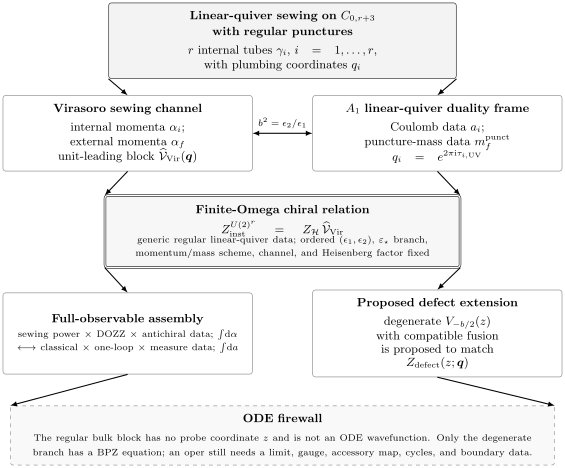
The operational layers of AGT for a linear quiver on a regularly punctured sphere. A pants decomposition simultaneously chooses a Virasoro sewing channel and an quiver duality frame; the corresponding gauge nodes are weakly coupled near its nodal cusp. The finite-Omega relation compares normalized chiral functions with the Heisenberg factor fixed. In the proposed defect extension, a further degenerate insertion is represented on the gauge side by defect data. Only that lower branch has a BPZ equation and, after additional limiting and gauge choices, an ODE wavefunction.
A pants decomposition chooses both channel and duality frame
Section titled “A pants decomposition chooses both channel and duality frame”Let be a stable genus- curve with marked points, so . A pants decomposition cuts it along
internal circles. Each thin tube has a plumbing coordinate near its degeneration. For the class- construction, the same data have two readings:
| Geometry of | Virasoro CFT | Four-dimensional gauge theory |
|---|---|---|
| Three-punctured sphere | Chiral three-point vertex | Matter building block with three flavor symmetries |
| Internal tube | Propagating Verma module | Gauged diagonal symmetry |
| Plumbing coordinate | Sewing variable | Exponentiated ultraviolet coupling in that frame |
| Internal label | Intermediate momentum | Coulomb special coordinate |
| External puncture label | External momentum | Flavor-mass datum |
| Change of decomposition | Fusion or modular transformation | Electric–magnetic duality frame change |
For a four-punctured sphere there is one tube. In the placement , its local sewing parameter is the cross-ratio , and the associated weakly coupled theory is with four fundamental hypermultiplets. In this sewing chart one writes
For the standard -node linear frame, one convenient placement of the punctures is
Thus the individual are plumbing coordinates even though the displayed puncture positions involve cumulative products.
This is a statement about the chosen ultraviolet coordinate. It does not identify with the effective coupling , and it does not make invariant under a change of pants decomposition. Crossing transformations act nontrivially on the puncture coordinate just as S-duality changes the weakly coupled gauge description.
The finite-Ω map fixes the central charge
Section titled “The finite-Ω map fixes the central charge”The correspondence is formulated before taking the NS limit. Choose a branch of the common Omega scale
The global convention fixed on the guide’s notation page is
Equivalently,
The central charge is symmetric under . The printed parameter is not: the exchange sends . The original AGT paper fixes its dimensionless parameters in the dual order. Translating that source into this guide therefore exchanges and while leaving and unchanged.
This convention makes the later limit transparent:
The exchange matters once a degenerate field is named. Our field has momentum and null vector ; a source using the dual convention may attach the same label to the field instead.
In particular, the source field with becomes the guide field , whose null relation contains . It is not the light used in the guide’s oper limit.
Coulomb and mass data must first be dimensionless
Section titled “Coulomb and mass data must first be dimensionless”Liouville momenta are dimensionless, while , , and have mass dimension one. Define
In a standard electric chart the internal momentum may be written
The Weyl reflection becomes the Liouville reflection . Depending on the real slice, one may instead write and integrate over real . The algebraic dictionary is complex and does not choose that contour by itself.
External momenta have the same centered form:
Here is a dimensionful centered puncture-mass variable, while is its dimensionless counterpart. The four are convention-dependent linear combinations of the four gauge-theory masses. They may also contain the equivariant centering shift before division by . The regular four-puncture chart fixes one complete mass basis. The operational lesson here is that “external momentum equals mass” is a role assignment, not a sign-complete formula.
The chiral equality needs a visible Heisenberg factor
Section titled “The chiral equality needs a visible Heisenberg factor”Place four nondegenerate Virasoro primaries at and propagate weight in the channel. The Chapter 6 normalization is
The instanton sum is normalized independently,
For the corresponding four-puncture theory, the finite-Omega AGT statement takes the schematic but normalization-complete form
Here is the Heisenberg or conventionally named factor. For four points it has the form
where is a bilinear expression in the chosen external momenta. The exponent depends on ordering, the mass convention, and reflection representatives. Local-coordinate or vertex normalizations may separately introduce external powers of ; these belong to , not to .
The equality can instead be read as a definition of the AGT-normalized traceless instanton block,
This quotient must not be confused with the instruction “set the center-of-mass Coulomb parameter to zero.” The pure vector factor may depend only on eigenvalue differences, but matter and quiver factors remember the decoupled Abelian sector through masses and couplings.
The leading sewing power contains the classical factor
Section titled “The leading sewing power contains the classical factor”The unit-leading instanton series corresponds to the hatted block, not to the OPE power multiplying it. If the centered momenta at and are and , then
Consequently,
This is the Chapter 10 Page 3 classical factor on the pure- slice, together with an external sewing normalization. The external factor is Coulomb-independent, but it contributes to a derivative and hence cannot be omitted from an accessory or Matone comparison.
One coefficient detects the normalization
Section titled “One coefficient detects the normalization”For a generic internal Verma module with , the first Virasoro coefficient was derived in Chapter 6:
Since
the AGT equality predicts
The same factor shifts a logarithmic coupling derivative:
Thus an -independent factor may be invisible to Coulomb extremization and still change an accessory or Matone relation.
This is an efficient check. A discrepancy that is independent of the internal Coulomb coordinate often signals the omitted Heisenberg factor; a discrepancy involving usually signals a mass shift, Coulomb normalization, or block-labeling error. Matching only the pole locations is weaker than matching the rational coefficient.
The formula does not apply unchanged to the vacuum module, where and the null descendant must first be removed. For a generic module the level-one term does not depend explicitly on because only propagates. A serious test continues to level two, where the inverse Gram matrix contains and sees the central charge. The AFLT construction explains the all-level Young-diagram expansion by using a special orthogonal basis of whose vertex matrix elements factorize as Nekrasov bifundamental weights.
A chiral block is not a Liouville correlator
Section titled “A chiral block is not a Liouville correlator”The local identity above compares holomorphic building blocks. A Liouville four-point correlator requires a spectrum, structure constants, an antiholomorphic pairing, and an integration contour. For real , external momenta on the physical line, and the undeformed principal contour, one reflection-normalized form is schematically
After analytic continuation of external momenta, this contour may have to be deformed and supplemented by discrete residues. That continuation is part of the full-correlator specification, not of the local block identity.
On the gauge side, the corresponding curved-space localization observable has the different schematic structure
Here the instanton factor is explicitly the stripped quantity
so the Heisenberg sector is not counted twice.
With the parameter map and contours understood, the remaining external normalization can be displayed as
Here collects the Coulomb-independent DOZZ/Barnes normalization not already included in the sewing factor.
After the Barnes-double-Gamma and DOZZ normalizations, measures, and external factors are aligned, these two integrals give the full AGT relation. The correspondence of factors is
| Gauge localization | Liouville decomposition |
|---|---|
| Coulomb-dependent part of the leading sewing power | |
| External prefactor multiplying the localization integral | Coulomb-independent |
| times the two DOZZ structure constants, up to external factors and the chosen reflection or measure convention | |
| Coulomb contour | Intermediate-momentum contour |
| Absolute square or north/south-pole pairing | Holomorphic–antiholomorphic pairing |
The precise real contour belongs to the curved-space problem. The local partition function treats as a parameter; the sphere integral makes it an integration variable. This is the same distinction that prevented Chapter 10 from extremizing a fixed Coulomb label without additional data. A holomorphic one-loop factor can be matched to a chiral square root of the DOZZ data only after choosing a definite Barnes-double-Gamma normalization scheme.
The original AGT comparison identifies the round- localization formula at the round-sphere point . A general real requires the four-dimensional ellipsoid background, or an explicitly stated analytic continuation of the chiral formulas; it is not an arbitrary- round-sphere identity.
The nondegenerate AGT block is not an ODE wavefunction
Section titled “The nondegenerate AGT block is not an ODE wavefunction”The four-point block in the chiral AGT equality contains four generic external modules. Virasoro symmetry recursively determines its sewing coefficients, but supplies no finite null relation. In particular,
depends on the modulus and is not a wavefunction of an independent ODE coordinate .
To obtain the second-order BPZ route, insert an additional degenerate field . The relevant object becomes a five-point block
Before fixing any insertion at infinity, its null relation gives the exact Ward identity
Möbius-fixing the four nondegenerate positions to turns the derivatives into a rational-coefficient operator that contains . Thus the finite- equation is generally a PDE in the probe coordinate and the modulus.
For a chiral block, the null descendant decouples only in a compatible fusion channel. Locally,
so the internal momenta immediately across the degenerate insertion must differ by , up to Liouville reflection. Merely replacing one generic weight by the degenerate value in an otherwise arbitrary block does not impose this condition.
A controlled heavy or NS limit can factor the nondegenerate bulk block from a defect wavefunction and turn the modulus derivative into an accessory coefficient. Normal-form gauges, mass shifts, operator ordering, and the energy map must still be supplied.
In the proposed, evidence-supported surface-defect extension of AGT, the extra insertion is identified with a surface defect or an equivalent ramified observable. Thus the faithful hierarchy is
Calling itself a Heun solution erases both the degenerate probe and its boundary or monodromy data.
An operational AGT comparison has nine entries
Section titled “An operational AGT comparison has nine entries”Before comparing an ODE calculation with a gauge or CFT formula, record the following specification.
- Surface and decomposition. State , puncture types, pants decomposition, and internal curves.
- Sewing chart. Give puncture positions, local coordinates, plumbing variables, and their branches.
- CFT block. Declare , external and internal momenta, reflection representatives, channel, and whether the OPE prefactor is included.
- Omega convention. State the ordered pair , the square-root branch, and whether or its dual is being translated.
- Gauge block. Specify the quiver, traceless Coulomb variables, mass convention, instanton variables, and whether the localization formula is written for or .
- Factor record. Separate classical, one-loop, instanton, Heisenberg, OPE-power, and external normalization factors.
- Parameter map. Give both directions for momenta, Coulomb moduli, masses, and couplings; do not suppress equivariant shifts.
- Equality status. Say whether the comparison is coefficientwise formal, convergent in a sewing disk, analytically continued, or an equality of integrated observables.
- ODE extension. If an ODE is claimed, identify the degenerate or defect insertion, limiting procedure, wavefunction gauge, accessory map, contour, and boundary data.
The specification turns AGT into a reproducible calculation. Without it, two correct formulas can disagree by a power of , a free-boson factor, a reflected momentum, or a shifted mass and still look deceptively similar.
Interpretation and limitations
Section titled “Interpretation and limitations”The original AGT paper proposed the correspondence and, in the four-puncture example, reported agreement through order . Later representation-theoretic work constructed the Virasoro–Heisenberg basis whose factorized matrix elements reproduce Nekrasov weights for generic parameters. This gives strong algebraic control of the chiral series used here. It does not turn every global physical formulation of six-dimensional compactification, every integration contour, or every analytic continuation into one unqualified theorem.
The page focuses on the or Virasoro case. The proposed and extensively tested higher-rank class- extension leads to Toda CFT and blocks, with extra momentum components and more intricate Abelian factors. Irregular punctures and confluent equations require scaling limits of both the CFT state and the gauge theory; those are Chapter 11 Page 3, not a substitution into the present regular formula.
Finally, equality of holomorphic blocks does not imply equality of Hilbert spaces or spectra. It transports protected functions and their analytic continuation after the dictionary is fixed. Chapter 10’s spectral firewall remains in force.
Common pitfalls
Section titled “Common pitfalls”Equating the wrong factors. A localization instanton sum is generally the Virasoro block times a Heisenberg factor. State whether that factor has been divided out before comparing coefficients.
Swapping the Omega planes silently. The central charge survives , so this error can hide until a degenerate field or NS limit is used. Track the null vector and Kac representative, not the label alone.
Mapping each Lagrangian mass directly to one puncture. The external momenta usually use a flavor-adapted linear basis and equivariant centering. Copying four signs from another paper without its fundamental/antifundamental convention corrupts the dictionary.
Calling the sewing variable an infrared coupling. It is the local UV coupling coordinate of a chosen duality frame. The effective Seiberg–Witten coupling depends on the Coulomb vacuum and masses.
Confusing a block with a correlator. A block has a fixed internal label and channel. A correlator also needs structure constants, antiholomorphic data, and an internal-momentum integral or sum.
Calling the bulk block a wavefunction. A generic four-point block has no second-order null equation. The ODE probe is supplied by an additional degenerate insertion or defect observable.
Exercises
Section titled “Exercises”1. Exchange the Omega planes
Section titled “1. Exchange the Omega planes”Starting from , exchange and . Show that and are unchanged, and identify what does change.
Solution
The exchange sends . With the compatible square-root choice ,
and is unchanged. The identification of the two degenerate momenta and , and hence the associated Kac labels and null equations, is exchanged. The other square-root choice sends while leaving unchanged.
2. Match Weyl and Liouville reflections
Section titled “2. Match Weyl and Liouville reflections”Let . Show that the Weyl reflection preserves the conformal weight and becomes Liouville reflection.
Solution
Under ,
Because
one has . The CFT reflection and gauge Weyl quotient therefore encode the same sign redundancy at the level of weights.
3. Recover the stripped one-instanton coefficient
Section titled “3. Recover the stripped one-instanton coefficient”Suppose
Find the coefficient of before and after Heisenberg stripping.
Solution
Since ,
Thus . Dividing by restores the Virasoro coefficient .
4. Count weakly coupled gauge nodes
Section titled “4. Count weakly coupled gauge nodes”How many gauge nodes arise from a pants decomposition of a stable ? Apply the result to and .
Solution
The number of internal tubes is , and each tube corresponds to one gauged diagonal symmetry. Hence both
have one gauge node. They correspond respectively to the four-flavor theory and the one-node adjoint-matter theory, with different surface topology and block geometry.
5. Separate block and correlator data
Section titled “5. Separate block and correlator data”Which additional inputs are required to turn a chiral four-point block into a Liouville four-point correlator?
Solution
One needs the allowed internal spectrum and contour or sum, two three-point structure constants, an antiholomorphic block, and a rule pairing the two chiralities. In the reflection-normalized convention used above, the Liouville spectrum is represented by
together with DOZZ structure constants. Equivalently, one may use the full real line modulo the reflection . None of these data is determined by the single holomorphic block.
6. Diagnose the missing ODE coordinate
Section titled “6. Diagnose the missing ODE coordinate”Why can not by itself be the solution of a Heun equation in ? Name the minimum extra CFT object.
Solution
The bulk block is a function of the modulus and contains no independent probe coordinate . Its four external modules are generic, so no level-two null vector closes a second-order differential equation. Insert and use the resulting five-point degenerate block; its null-state decoupling equation supplies the second derivative in . The adjacent channel must also obey
up to Liouville reflection. A degenerate numerical weight inside a generic incompatible sewing channel is not enough.
7. Identify a UV/IR category error
Section titled “7. Identify a UV/IR category error”Explain why the substitution is not the basic AGT sewing dictionary.
Solution
The sewing coordinate labels the ultraviolet Lagrangian frame and is identified locally with . The effective coupling is a period-matrix entry of the Seiberg–Witten geometry and depends on the Coulomb vacuum and masses. Replacing one by the other mixes theory data with vacuum data.
8. Build a minimal coefficient tuple
Section titled “8. Build a minimal coefficient tuple”List the data needed before comparing a published one-instanton coefficient with .
Solution
At minimum record the ordering of , the branch of , the Coulomb normalization, centered versus equivariant masses, the four external-label ordering, the internal channel, whether the block includes its leading OPE power, the instanton variable, and the Heisenberg exponent . Only after these entries agree is a coefficient comparison meaningful.
References
Section titled “References”- D. Gaiotto, “N=2 Dualities”, Journal of High Energy Physics 08 (2012) 034. Sections 2–4 develop the punctured-curve construction, pants decompositions, generalized quivers, and the identification of degeneration limits with weakly coupled duality frames.
- L. F. Alday, D. Gaiotto, and Y. Tachikawa, “Liouville Correlation Functions from Four-dimensional Gauge Theories”, Letters in Mathematical Physics 91 (2010), 167–197. Section 3 states the instanton/block map: equations (3.5)–(3.13) work out the four-punctured sphere and isolate the Abelian factor, while equations (3.17)–(3.20) give the linear-quiver sewing map. Equations (4.1)–(4.7) match one-loop factors and integrated full partition functions to Liouville correlators; Table 1 gives the original convention dictionary. Appendix B records the localization factors, mass shifts, and reflection subtleties; Appendix C gives the explicit proposed factors.
- L. F. Alday, D. Gaiotto, S. Gukov, Y. Tachikawa, and H. Verlinde, “Loop and Surface Operators in N=2 Gauge Theory and Liouville Modular Geometry”, Journal of High Energy Physics 01 (2010) 113. Equations (2.5)–(2.7) state the regular fixed-Coulomb block map in the source’s reciprocal convention; equations (2.12)–(2.16) add the proposed defect/degenerate extension, its new coordinate, and the semiclassical open-period relation. The fusion qualification immediately after equation (2.12), elaborated in Appendix B.1, is essential for a chiral block.
- V. A. Alba, V. A. Fateev, A. V. Litvinov, and G. M. Tarnopolsky, “On Combinatorial Expansion of the Conformal Blocks Arising from AGT Conjecture”, Letters in Mathematical Physics 98 (2011), 33–64. Section 1 gives the Heisenberg-dressed conformal-block expansion in equations (1.9) and (1.11)–(1.13). Proposition 2.1 and its proof in Section 3 construct the orthogonal basis whose matrix elements are Nekrasov bifundamental factors; the concluding section identifies the Abelian factor as a free-boson correlator.
- J. Teschner, “Liouville Theory Revisited”, Classical and Quantum Gravity 18 (2001), R153–R222. The spectrum discussion supports the reflection-normalized principal contour; Appendix B.2 proves meromorphic continuation by contour deformation and the residue contributions generated when poles cross that contour.
- N. Nekrasov, “Seiberg–Witten Prepotential from Instanton Counting”, Advances in Theoretical and Mathematical Physics 7 (2003), 831–864. Sections 2–3 define the equivariant instanton partition function and its Young-diagram expansion that supplies the gauge side of the chiral correspondence.
- N. Wyllard, “ Conformal Toda Field Theory Correlation Functions from Conformal Quiver Gauge Theories”, Journal of High Energy Physics 11 (2009) 002. The paper proposes and tests the higher-rank extension from Virasoro/ AGT to Toda theory, symmetry, and quivers.
- V. Pestun, “Localization of Gauge Theory on a Four-Sphere and Supersymmetric Wilson Loops”, Communications in Mathematical Physics 313 (2012), 71–129. The localization formula expresses the round-four-sphere observable as a Cartan integral with north- and south-pole instanton factors, providing the gauge-theory structure used in the full-correlator layer.
- N. Hama and K. Hosomichi, “Seiberg–Witten Theories on Ellipsoids”, Journal of High Energy Physics 09 (2012) 033. The paper constructs the four-dimensional ellipsoid localization background and its two equivariant parameters, which geometrizes the finite Liouville parameter beyond the round-sphere point.