
Regular Punctures: HeunG, Liouville Blocks, and SU(2) with Four Flavors
The four-punctured Riemann sphere is the smallest example in which all three sides of the ODE/CFT/gauge dictionary are nontrivial. In the declared AGT/Nekrasov sewing scheme, its one cross-ratio is the ultraviolet coupling of four-dimensional theory with four flavors. A nondegenerate Virasoro four-point block in a chosen sewing channel matches the normalized instanton series. After an additional degenerate insertion and a controlled heavy or NS limit, the same background supports a four-singularity Heun oper.
Those statements involve different functions and different independent variables. The bulk block depends on the modulus; the degenerate block depends on the modulus and a probe position; HeunG is one normalized local germ in the probe coordinate. This page fixes one complete mass scheme and carries the distinction all the way to the standard Heun accessory parameter.
Four regular punctures give one modulus and three cusps
Section titled “Four regular punctures give one modulus and three cusps”Fix the ordered background punctures at
Throughout this chart,
is the original AGT/Nekrasov instanton coordinate near the cusp. A finite renormalization can define another ultraviolet coordinate; is also not the infrared nome or effective coupling.
A circle separating from selects the sewing channel. Near the circle becomes a long thin tube. The same tube carries an intermediate Virasoro module and the weakly coupled gauge node:
The other two collision points of the cross-ratio are equally physical. They describe different weakly coupled frames:
| Cusp | Pair separated by the long tube | Local weak-coupling coordinate |
|---|---|---|
These are the three pants decompositions behind the familiar triality of the theory. A change of cusp changes the sewing channel and the weakly coupled Lagrangian frame. It does not merely replace one small number by another while leaving all labels fixed.
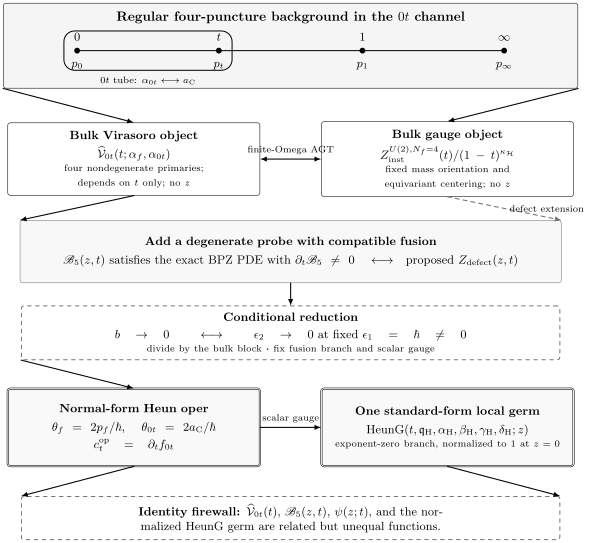
The regular four-puncture prototype. The background modulus is the ultraviolet gauge fugacity, the tube label is the Coulomb or internal-momentum datum, and appears only after the extra degenerate probe is inserted. The bulk four-point block is therefore not a HeunG wavefunction. The lower arrow is the proposed defect extension followed by a conditional heavy or NS reduction.
The bulk equality uses four nondegenerate primaries
Section titled “The bulk equality uses four nondegenerate primaries”Let
be the unit-leading Virasoro block with external fields at and internal momentum . All four external modules are generic here. There is no null vector and no probe coordinate.
On the gauge side, use the localization representative with Coulomb eigenvalues , two antifundamental masses , and two fundamental masses . Write ; then
The split into two antifundamentals and two fundamentals is a convenient fixed-point bookkeeping representative. The doublet is pseudoreal; changing the printed orientation is allowed only together with the corresponding equivariant mass reflection and Heisenberg factor.
The detailed box factors were defined in Chapter 10. What matters here is the precise regular AGT identity
after the mass map below is imposed. The factor
is the Heisenberg or conventionally named block. It is Coulomb-independent but not modulus-independent. The AGT-normalized traceless representative in this convention is the quotient
This notation records a normalization prescription, not the instruction “set the Abelian Coulomb coordinate to zero.” The original AGT paper presented the equality as a conjecture and checked its instanton expansion; later Virasoro–Heisenberg bases explain the factorized Nekrasov matrix elements algebraically. The displayed identity is used here as the standard generic formal-series correspondence in its declared scheme.
The unhatted Virasoro block additionally contains
That power matches a classical gauge factor times an external sewing normalization, not the unit-leading instanton sum.
The first coefficient is an immediate check
Section titled “The first coefficient is an immediate check”Write
For a generic internal Verma module with ,
Expanding the Heisenberg factor gives the concrete prediction
The two one-box fixed points also compute the left-hand side directly. In the printed matter convention, write and define
Then
The Weyl reflection exchanges the two colored-box contributions, and every summand is dimensionless. These are useful checks before any conformal-block substitution.
After substituting the mass dictionary below, this rational identity checks the external-label order, the equivariant shifts, the Coulomb normalization, and the Heisenberg exponent at once. Agreement of pole locations without agreement of this numerator is not a complete check.
One four-flavor mass scheme makes every shift visible
Section titled “One four-flavor mass scheme makes every shift visible”Retain the guide convention
Some original AGT formulas denote this sum by . This guide reserves because other sources use for half the sum.
The original AGT four-flavor formula sets the common scale to one and uses the reciprocal convention. Restoring dimensions and translating to this guide exchanges with but leaves unchanged.
Take to be antifundamental Nekrasov masses and to be fundamental Nekrasov masses in that representative. Define four dimensionful centered puncture masses by
The external and internal Liouville momenta are then
The inverse mass map is equally important:
Thus the four external momenta are not the four printed one by one. Two use differences; two use shifted sums. The shift is exactly the equivariant centering that disappears if one copies only the classical mass relation.
For comparison with the source’s dimensionless notation, put and define
The source map becomes
and fixes the Heisenberg exponent to
Two elementary reflection checks are already visible. Exchanging sends and therefore while leaving fixed. Similarly, realizes Liouville reflection at . The Coulomb Weyl reflection sends .
The fifth insertion creates the Heun coordinate
Section titled “The fifth insertion creates the Heun coordinate”The bulk relation above has only the modulus . To obtain a second-order equation in a new coordinate, insert and choose an adjacent channel satisfying the degenerate fusion rule. The chiral object becomes
If and label the channels immediately across the probe, compatibility requires
up to Liouville reflection. Merely assigning the degenerate numerical weight to a generic five-point sewing graph does not impose null-state decoupling.
After the global Ward identities are used, the exact equation can be written
where
and
Here
The modulus derivative is nonzero. Even after a numerical value of has been chosen, is not set to zero. At finite this is a two-variable BPZ PDE, often called a nonstationary Heun equation, rather than the ordinary HeunG equation.
Under the proposed defect extension of AGT, the new object is represented by a surface-defect partition function:
This proposed gauge identification must be kept distinct from the exact CFT null equation.
The NS shadow is a four-pole oper
Section titled “The NS shadow is a four-pole oper”Take the guide’s NS direction
Use the centered-mass NS path: hold the dimensionful puncture masses , the Coulomb modulus , and fixed. The equivariant labels in the inverse specification then acquire the corresponding centering shift as the limit is taken. This path gives the oriented exponent differences
This is not only a dimensional mnemonic. At finite one has the exact identity
and therefore
Define
The four become the local double-pole coefficients of the oper. The internal quantity has a different job: it selects the monodromy or classical-block branch and thereby helps determine the accessory residue.
Let
be the full background block in the same channel. After fixing a fusion-compatible local normalization, write the five-point block as
On a fixed logarithm branch, assume the derivative-compatible limits
Equivalently, the five-point block has the leading factorization
The derivative limits are genuine hypotheses: pointwise convergence of alone does not justify differentiating its limit. This is one reason the oper statement is conditional rather than an exact finite-Omega identity.
Then the leading equation is
with
where
The last equality uses the full, unhatted block. If
then
The Heisenberg factor survives the NS limit
Section titled “The Heisenberg factor survives the NS limit”The classical/NS conversion uses
Define both NS quantities on the centered-mass path used above:
The hatted bulk equality then implies
including the same logarithm branch on both sides. Chapter 10 declares its raw localization limit at fixed printed instead. Translating a result from that path requires recentering the mass dictionary before the coupling derivative is compared; the resulting finite or contact terms belong to the normalization specification. Derivatives from the two paths must not be mixed silently.
The survival can be seen in closed form. The mass dictionary gives
so on the centered path
Since itself grows on the heavy branch, the Heisenberg contribution need not vanish after multiplication by . Therefore an accessory extracted from the raw series must subtract the Heisenberg derivative and restore the chosen OPE power before it can equal .
This is the regular four-flavor instance of the Matone/accessory warning: a coupling derivative becomes a printed ODE coefficient only after its contact, Abelian, and scalar-gauge terms have been fixed.
HeunG requires one final scalar gauge
Section titled “HeunG requires one final scalar gauge”The oper is already a general four-singularity equation, but HeunG refers to the exponent-zero solution of the house first-derivative form. Define oriented standard-Heun parameters by
They obey
and
The compact normal-form accessory is
The standard Heun accessory is the affine coordinate
Consequently
This is the promised separation of roles:
They are respectively a position modulus, a Coulomb coordinate, a normal-form residue, and a standard-form accessory parameter.
Now set
Then satisfies
Choose the oper branch , the displayed branches of the scalar gauge, and the multiplicative constant for which . Provided
the resulting local germ is
The unit-leading normalization can be checked before any global continuation:
Positive-integer is resonant but does not obstruct this exponent-zero normalized germ; it is generally the second local solution that develops a logarithm. When , the unit-leading recurrence can instead be obstructed or nonunique and needs a compatibility condition or a parameter limit. HeunG is not a name for the full solution space or for the ungauged defect wavefunction.
Specify every parameter needed to invert the regular dictionary
Section titled “Specify every parameter needed to invert the regular dictionary”The central entries can now be read in either direction.
| ODE or CFT datum | Gauge-theory datum | Convention and excluded locus | Source or status |
|---|---|---|---|
| Cross-ratio in the channel | Declared local coordinate near ; not the infrared nome or effective coupling | Gaiotto §2; AGT App. B.1, Eq. (B.1), and App. B.3 | |
| Internal | Coulomb modulus | Weyl/reflection sign fixed; generic away from Kac poles | AGT §3.2 |
| External | Shifted sums and differences of | Two antifundamentals plus two fundamentals in the printed representative | AGT Eqs. (3.7)–(3.13), Apps. B.1–B.2 |
| Generic formal series; OPE power excluded | AGT §3.2; AFLT Proposition 2.1 | ||
| Five-point block | Proposed defect function | Compatible fusion channel; not a universal defect theorem | AGGTV §1.2 and §§2.1–2.2 |
| Normalized NS coupling derivative | Heavy/NS factorization, log branch, Heisenberg and OPE factors fixed | Piątek–Pietrykowski | |
| HeunG local germ | Gauge-fixed local defect branch | for the direct normalized germ | DLMF §§31.2(i)–(ii), 31.3(i) |
Given the right column and the declared mass convention, the table constructs a CFT block and then an ODE probe. Given a Heun oper, the reverse direction first extracts oriented exponent differences, a modulus, and an accessory. It does not by itself choose the fundamental versus antifundamental representative, a Coulomb sign, a defect realization, or a spectral boundary condition.
S-duality changes the chart and flavor basis
Section titled “S-duality changes the chart and flavor basis”The four-flavor theory has an enhanced flavor symmetry, while the chosen pants decomposition displays only an subgroup. The three pairings of the four punctures correspond to three weakly coupled frames and to the vector, spinor, and conjugate spinor presentations related by triality.
For the CFT block, changing the pairing is a fusion transformation. For the gauge theory, it is an electric–magnetic duality together with a reorganization of the flavor masses. For the Heun equation, it is a Möbius transformation of the singularities followed by an exponent gauge and an affine transformation of the accessory parameter.
Therefore neither
nor
may be performed while keeping numerically fixed. The transformed channel has a different internal coordinate, a permuted or triality-rotated mass basis, and a transformed local solution normalization. What is invariant is the underlying theory or global continuation problem after the complete dictionary has been transported.
Interpretation and limitations
Section titled “Interpretation and limitations”This regular prototype explains why AGT is powerful without making it a universal solution formula. The bulk equality identifies a chiral Virasoro block with the protected instanton series in the modulus and gives a highly effective expansion for the classical block. A full Liouville four-point correlator would additionally require structure constants, holomorphic–antiholomorphic pairing, and an internal-momentum integral. After the heavy or NS reduction, the degenerate extension supplies a two-component local system in the probe coordinate; at finite it remains the two-variable BPZ PDE above. Its limiting accessory is fixed by a logarithmic derivative of the background block, so instanton coefficients can determine a Heun equation order by order in the weak-coupling coordinate.
The construction is local in parameter space. It assumes a chosen sewing disk, logarithm branch, reflection representatives, and generic nonresonant data. Analytic continuation can cross block singularities or semiclassical saddle walls. The limiting Heun equation still does not choose a self-adjoint domain, a scattering contour, a quasinormal condition, or any other spectral realization.
Finally, at fixed masses is the nodal weak-coupling boundary of the regular four-puncture theory; by itself it does not create an irregular puncture. A confluent Heun equation requires a coordinated collision or flavor-decoupling limit in which masses or momenta, the coupling, the accessory, and the wavefunction normalization are rescaled. The next page derives that irregular limit in the same matter and Heisenberg normalization.
Common pitfalls
Section titled “Common pitfalls”Using one symbol for three jobs. The gauge fugacity , Coulomb modulus , and Heun accessory occupy distinct roles and are not interchangeable coordinates. Within a matched AGT family the accessory is determined from the modulus, masses, Coulomb or branch data, and the classical-block derivative. A formula that calls several of these objects or must be renamed before it is compared.
Calling the bulk block HeunG. The nondegenerate four-point block depends on and matches the bulk instanton series. The Heun coordinate enters only with the additional degenerate or defect observable.
Dropping the equivariant mass shift. In the displayed convention, and contain . Omitting it corrupts the external weights even when the classical mass relation looks plausible.
Discarding the Abelian factor before differentiating. The Heisenberg factor is independent of but depends on and heavy masses. It changes the NS coupling derivative and hence the accessory relation.
Freezing the modulus inside the finite- PDE. Choosing a value of does not make vanish. Only the heavy or NS factorization converts its leading action into multiplication by an accessory coefficient.
Treating S-duality as a bare cross-ratio substitution. A new cusp comes with a new channel, Coulomb coordinate, flavor basis, and Heun normalization. Transport the whole specification.
Exercises
Section titled “Exercises”
1. Invert the mass dictionary
Section titled “1. Invert the mass dictionary”Starting from the four in terms of , recover all four and identify where the equivariant shift enters.
Solution
The difference and shifted-sum equations give
The shift occurs in the average of each pair. It is absent from the differences and , so checking only those two punctures cannot detect a missing equivariant centering.
2. Match Weyl and puncture reflections
Section titled “2. Match Weyl and puncture reflections”Show what and do to the corresponding Liouville momenta.
Solution
The mass exchange fixes and sends . Hence
Likewise,
under the Coulomb Weyl reflection. Both transformations preserve the corresponding conformal weights.
3. Recover the one-instanton shift
Section titled “3. Recover the one-instanton shift”First check that the displayed one-box expression is dimensionless and Weyl invariant. Then use to derive the coefficient of . Finally, substitute the mass dictionary and verify the direct localization result against .
Solution
Each has mass dimension four, while also has dimension four. Under , the and summands exchange, including their denominators, so their sum is Weyl invariant.
Next,
multiplication gives
Thus . Dividing by the Heisenberg factor restores the unit-leading Virasoro coefficient.
For the full check, use
together with . After the four inverse mass formulas are inserted, both and the two-box sum reduce to the same rational function with possible poles only at and . Bringing the difference over that common denominator gives an identically zero numerator. This checks the mass ordering and the equivariant centering, not only the pole set.
4. Extract the surviving modulus derivative
Section titled “4. Extract the surviving modulus derivative”Why can the nondegenerate four-point block not solve the Heun equation in ? What is the minimum CFT replacement? For that replacement, use to identify which part of survives the heavy limit.
Solution
The bulk block has the single variable , the modulus of . A Heun wavefunction requires an independent coordinate moving among the four fixed singularities. Inserting in a channel whose adjacent labels differ by , up to reflection, produces a five-point block with both variables and a level-two null equation. At finite that equation is still a PDE.
For its modulus derivative,
After the common heavy exponential is divided out, the declared limits give
The derivative of the finite probe ratio is suppressed, while the derivative of the heavy background becomes the accessory term.
5. Read ODE exponents from masses
Section titled “5. Read ODE exponents from masses”Use and to show that the oper exponent difference at puncture is .
Solution
The centered heavy momentum gives
Therefore and the two local normal-form powers are . No factor of remains in the NS oper.
6. Check the Heun Fuchs relation
Section titled “6. Check the Heun Fuchs relation”Verify that the five oriented Heun exponent parameters defined above satisfy the Fuchs relation.
Solution
The finite-point sum is
Meanwhile,
Adding one to the latter gives the former. The difference fixes the oriented exponent difference at infinity.
7. Convert the oper residue to the Heun accessory
Section titled “7. Convert the oper residue to the Heun accessory”Starting from
and
solve for . Then insert into the standard Heun equation and recover .
Solution
The first equation gives
Substitution into the second yields
The shift is affine and depends on the local exponent gauge. Thus the standard accessory is not the moving-pole residue.
For the local series, the terms of order after multiplication by give
Hence
which is the unit-leading HeunG checksum.
8. Move to another weak-coupling cusp
Section titled “8. Move to another weak-coupling cusp”Set and . Relabel the four puncture masses so that the transformed points again appear as , and compute the four new printed masses from the same specification. How does the moving-pole oper residue transform? Explain what is still not fixed by this relabeling.
Solution
The map sends the old points to , so
Applying the same two-antifundamental/two-fundamental specification gives
Because and the Möbius Schwarzian vanishes, the simple-pole residue at the moving point changes orientation:
The new tube represents the old pairing. Its internal momentum or electric Coulomb coordinate must be obtained by fusion or S-duality; it is not fixed by permuting the external masses. The scalar-gauge branches and the standard accessory must then be recomputed in the transformed chart. Thus replacing by alone is incomplete.
References
Section titled “References”- D. Gaiotto, “N=2 Dualities”, Journal of High Energy Physics 08 (2012) 034. Section 2, especially equations (2.7)–(2.12) and Figure 3, identifies the four-punctured sphere, its pants decompositions, the theory, and the three weakly coupled duality frames.
- L. F. Alday, D. Gaiotto, and Y. Tachikawa, “Liouville Correlation Functions from Four-dimensional Gauge Theories”, Letters in Mathematical Physics 91 (2010), 167–197. Section 2 explains the four-puncture flavor triality. Section 3.2, especially equations (3.5)–(3.13), fixes the fundamental/antifundamental mass basis, external and internal momenta, and the four-point Heisenberg factor. Appendix B.1 fixes the ultraviolet instanton coordinate and matter orientation; Appendix B.2 explains the equivariant mass-zero shift; Appendix B.3 distinguishes the ultraviolet coordinate from the infrared nome.
- L. F. Alday, D. Gaiotto, S. Gukov, Y. Tachikawa, and H. Verlinde, “Loop and Surface Operators in N=2 Gauge Theory and Liouville Modular Geometry”, Journal of High Energy Physics 01 (2010) 113. Section 2 proposes the relation between a degenerate insertion and a surface defect. Section 1.2 labels this a conjecture or working hypothesis. Section 2.1, equation (2.6), records the source’s reciprocal- convention, while Section 2.2 records the necessary fusion restriction.
- V. A. Alba, V. A. Fateev, A. V. Litvinov, and G. M. Tarnopolsky, “On Combinatorial Expansion of the Conformal Blocks Arising from AGT Conjecture”, Letters in Mathematical Physics 98 (2011), 33–64. Proposition 2.1 constructs the generic Virasoro–Heisenberg basis whose factorized matrix elements reproduce the Nekrasov weights.
- A. A. Belavin, A. M. Polyakov, and A. B. Zamolodchikov, “Infinite Conformal Symmetry in Two-Dimensional Quantum Field Theory”, Nuclear Physics B 241 (1984), 333–380. The level-two null-state relation gives the exact differential equation for the degenerate probe.
- M. Piątek and A. R. Pietrykowski, “Solving Heun’s Equation Using Conformal Blocks”, Nuclear Physics B 938 (2019), 543–570. The paper analyzes heavy–light factorization of five-point degenerate blocks and the resulting Heun normal form and local solutions.
- NIST Digital Library of Mathematical Functions, Chapter 31, “Heun Functions”. Sections 31.2(i)–(ii) and 31.3(i), especially equations (31.2.1)–(31.2.4) and (31.3.1)–(31.3.4), define the standard equation, normal form, exponent data, and normalized local germ used in the final crosswalk. DLMF’s convention corresponds to here; the site calls DLMF’s normalized germ HeunG.