
Degenerate Fields and Null-Vector Decoupling
A degenerate Virasoro field is not merely a primary whose weight happens to take a special value. Its Verma module contains a proper null submodule, and the chiral vertex operators of the degenerate theory factor through the quotient by that submodule. This quotient turns an algebraic state relation into a differential identity for every block containing the field.
For the light field , the first relation occurs at level two. The two descendant directions and collapse to one, so the stress-tensor Ward hierarchy closes at second order in . The result is the exact finite-central-charge BPZ equation. It is an ODE only when the remaining coordinate dependence can be eliminated; with independent moduli it is a PDE.
Degeneracy is a quotient condition
Section titled “Degeneracy is a quotient condition”Keep the conventions of the chapter overview:
For positive integers , define the uncentered Kac momentum
Its weight is
The reflected momentum gives the same weight. In centered coordinates, , the chosen Kac representative is . A source using centered momenta may therefore display this value where the guide displays .
At generic , the Verma module has a primitive singular vector at level . The Kac determinant records this statement at every level:
Here depends on the PBW basis and is the partition number, with . When Kac weights collide at special , several factors describe the same numerical weight and the embedding structure requires extra care.
The primitive vector at level begins with an term. After decoupling, it produces a differential constraint of order in the degenerate coordinate. Independent moduli can still leave that constraint as a PDE; higher level does not remove the same ODE-versus-PDE qualification encountered at level two.
The determinant is computed in the Verma module. Its zero identifies a radical of the contravariant form; it does not automatically remove that radical. Let be the null submodule generated by the primitive singular vector. For generic , this is the full maximal proper submodule, and the degenerate irreducible module is
At a collision locus with additional singular vectors, must be replaced by the full radical or maximal proper submodule.
This quotient is the representation-theoretic content of “null-vector decoupling.”
The level-two kernel fixes the weight and the null vector
Section titled “The level-two kernel fixes the weight and the null vector”The level-two space has basis
Start with the candidate
A level-two state is singular precisely when and ; modes with then annihilate it automatically because recursively generates the positive modes from and . The Virasoro commutators give
Thus
and eliminating leaves
Substituting gives two branches:
| Kac label | Weight | Coefficient in |
|---|---|---|
The same result is visible in the exact level-two determinant:
The factor is the descendant of the level-one identity-module singular vector. The other two factors are the genuinely level-two branches.
For the branch used in the guide’s ODE limit,
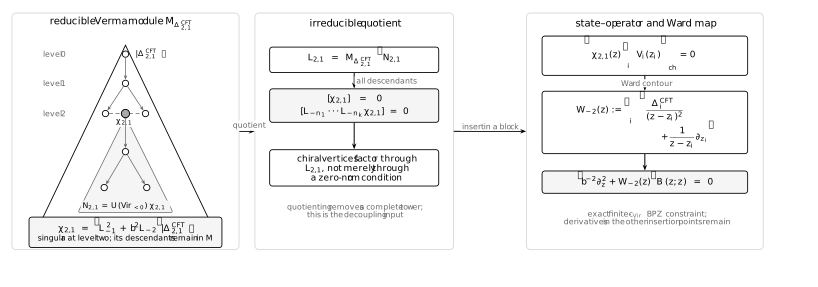
The singular state generates a full descendant submodule inside the Verma module. Passing to the irreducible quotient sets this submodule to zero. Under state–operator correspondence, the level-two relation becomes the BPZ differential constraint on a chiral block.
The quotient removes a whole tower
Section titled “The quotient removes a whole tower”At generic , the submodule generated by begins two levels above the highest-weight state and has one descendant for every partition above that shift. The quotient character is therefore
The first dimensions make the subtraction concrete:
| Level | Verma states | Null descendants | Quotient states |
|---|---|---|---|
| 0 | 1 | 0 | 1 |
| 1 | 1 | 0 | 1 |
| 2 | 2 | 1 | 1 |
| 3 | 3 | 1 | 2 |
| 4 | 5 | 2 | 3 |
| 5 | 7 | 3 | 4 |
For example, writing for equality in the quotient, the level-two relation is
Acting once with and restoring PBW order gives the level-three descendant relation
Thus quotienting does not delete one isolated state; it removes its entire descendant tower. At rational or logarithmic loci, additional singular vectors and submodule intersections can alter this simple character subtraction.
The dual branch follows from . With held fixed, is light whereas is heavy. The two labels must not be exchanged without also exchanging the semiclassical scaling.
A singular state becomes a local field identity
Section titled “A singular state becomes a local field identity”Under state–operator correspondence, the singular state gives the descendant field
In the irreducible quotient,
This is an operator statement inside chiral blocks whose vertices factor through . In particular, for a chosen chiral block
null-submodule decoupling requires
The symbol can denote one chiral block or a chiral correlator assembled from blocks. The decoupling operator is linear, so every admissible block and any admissible linear combination obey it.
The first descendant is already differential:
The nontrivial step is to express through derivatives with respect to the other insertions.
The Ward contour turns the second descendant into derivatives
Section titled “The Ward contour turns the second descendant into derivatives”Modes acting on a field at are defined by a local stress-tensor contour. For the required mode,
Insert this expression into and move the contour away from . Near another primary , the Ward OPE is
The residue of at has a minus sign, and the contour deformation contributes a second minus sign. Assuming no additional contour contribution at infinity, the result is
If a field is ultimately placed at infinity, first derive the equation at finite position and then take the normalized limit. This avoids silently losing its contribution.
Substituting the two descendant identities into null decoupling and dividing by gives the finite-central-charge BPZ equation
This equation is exact. No heavy–light limit has been taken, and the derivatives are part of the operator rather than accessory constants.
The displayed Ward operator assumes distinct, regular primary insertions. Descendant or irregular insertions have different stress-tensor Ward terms and will be treated separately in the confluent part of the chapter.
For the dual field , the null coefficient is , so the corresponding unreduced equation is
Three global identities decide ODE versus PDE
Section titled “Three global identities decide ODE versus PDE”On the sphere, invariance under , , and supplies three global Ward identities:
and
These identities remove the coordinate dependence associated with three Möbius directions. What remains depends only on cross-ratios.
| Insertion content | Independent cross-ratios | Result after fixing three positions |
|---|---|---|
| Three nondegenerate fields plus | One | A closed second-order ODE in the degenerate cross-ratio |
| Four nondegenerate fields plus | Two | A second-order PDE in the probe coordinate and one background modulus |
| More nondegenerate fields plus | More than two | A BPZ PDE with several moduli |
Thus a level-two null vector guarantees second order in the degenerate coordinate. It does not guarantee that all other derivatives disappear. “BPZ equation” and “second-order ODE” are not synonyms.
The two fusion shifts reappear as local exponents
Section titled “The two fusion shifts reappear as local exponents”The differential equation also remembers the degenerate fusion rule. Bring the probe close to a primary and write . This is the same leading-power test used for regular singularities. For a generic local branch,
At leading order, . The most singular terms in the BPZ equation therefore give
Equivalently,
Introduce the centered momentum and a fusion sign . The two roots are
They equal the two OPE exponents
Hence
The differential equation sees two local powers; representation theory identifies their intermediate momenta. Which branch appears in a full correlator also depends on spectrum and OPE coefficients.
The dual exchange instead gives shifts and local exponents and .
Common pitfalls
Section titled “Common pitfalls”Substituting a Kac weight without taking the quotient. A generic block formula uses inverse Gram matrices and becomes singular at a Kac zero. The degenerate block is defined by removing the null submodule, not by blind substitution into the singular generic expression.
Treating zero norm as automatic decoupling. Decoupling follows because the representation and chiral vertices factor through the irreducible quotient. In logarithmic or indecomposable theories, a zero-norm state can participate in nontrivial pairings and must be analyzed separately.
Dropping the coordinate derivatives in the Ward operator. The terms are exact at finite central charge. Global symmetry eliminates only three coordinate directions; genuine moduli remain.
Swapping the two Kac labels at fixed scaling. The algebra is related by , but and have different behavior when the limit is held fixed.
Confusing an internal degeneracy with a probe insertion. A coordinate-space BPZ equation comes from an inserted degenerate field. Putting a degenerate module only on an internal sewing edge instead constrains the adjacent intertwiners and does not create a new probe coordinate.
Exercises
Section titled “Exercises”1. Locate the level-one degenerate module
Section titled “1. Locate the level-one degenerate module”Use to identify the level-one Kac weight and its singular vector. What does the quotient imply for the corresponding field?
Solution
The determinant vanishes at . The state is annihilated by every positive mode and generates the null submodule. In the quotient,
Under state–operator correspondence this becomes . With the standard vacuum normalization, is the identity field.
2. Factor the level-two determinant
Section titled “2. Factor the level-two determinant”Starting from
show that its determinant has the two Kac factors displayed in the text.
Solution
Direct expansion gives
The quadratic roots are and . Since the bracketed quadratic has leading coefficient ,
3. Derive the singular-vector coefficient
Section titled “3. Derive the singular-vector coefficient”Apply and to and recover both level-two branches.
Solution
The commutators give
Setting both results to zero first gives and then the Kac quadratic. Substitution yields
4. Check the contour-deformation sign
Section titled “4. Check the contour-deformation sign”Compute the residue at of
Explain why the final Ward operator has a plus sign.
Solution
The double-pole residue differentiates :
The simple-pole residue is . Thus the residue around is the negative of the operator in the text. Moving the original contour around to all other insertions contributes another minus sign, leaving the displayed plus sign.
5. Recover the two local fusion exponents
Section titled “5. Recover the two local fusion exponents”Insert into the BPZ equation and verify the two momentum shifts.
Solution
The leading equation is
Its roots are
Using , these are . Direct evaluation gives
6. Count the surviving variables
Section titled “6. Count the surviving variables”A sphere block contains one degenerate and nondegenerate insertions. How many independent cross-ratios remain, and for which does the BPZ equation close to an ODE without a semiclassical limit?
Solution
There are insertion coordinates. Quotienting by the three complex Möbius directions leaves
cross-ratios. For , the sole cross-ratio can be chosen as the degenerate coordinate, so the BPZ equation is an ODE. For , two variables remain: the degenerate coordinate and a background modulus. The exact equation is then a PDE.
7. Apply the duality check
Section titled “7. Apply the duality check”Exchange in the weight and null vector. What changes in the scaling?
Solution
The exchange gives
The algebraic formulas are dual. At fixed , however, while . The first insertion is light and the second is heavy. They become interchangeable only after the dual scaling is exchanged as well.
References
Section titled “References”- V. G. Kac, “Contravariant Form for Infinite-Dimensional Lie Algebras and Superalgebras”, in Group Theoretical Methods in Physics, Lecture Notes in Physics 94 (1979), 441–445. Contravariant forms, determinant zeros, and reducibility of highest-weight modules.
- A. A. Belavin, A. M. Polyakov, and A. B. Zamolodchikov, “Infinite Conformal Symmetry in Two-Dimensional Quantum Field Theory”, Nuclear Physics B 241 (1984), 333–380. Degenerate Virasoro representations, null-vector decoupling, and BPZ equations.
- P. Di Francesco, P. Mathieu, and D. Sénéchal, Conformal Field Theory, Springer, 1997. Detailed derivations of Kac determinants, singular vectors, Ward identities, and degenerate-field differential equations.
- S. Ribault, Conformal Field Theory on the Plane, 2014. Accessible treatment of Virasoro representations, degenerate fields, fusion rules, and BPZ equations in complex-momentum conventions.
- J. Teschner, “Liouville Theory Revisited”, Classical and Quantum Gravity 18 (2001), R153–R222. Chiral operators, degenerate representations, and Liouville normalization.
- G. Bonelli, C. Iossa, D. Panea Lichtig, and A. Tanzini, “Irregular Liouville Correlators and Connection Formulae for Heun Functions”, Communications in Mathematical Physics 397 (2023), 635–727. Finite-central-charge BPZ PDEs, their classical ODE limits, and the centered-momentum convention crosswalk used in this chapter.