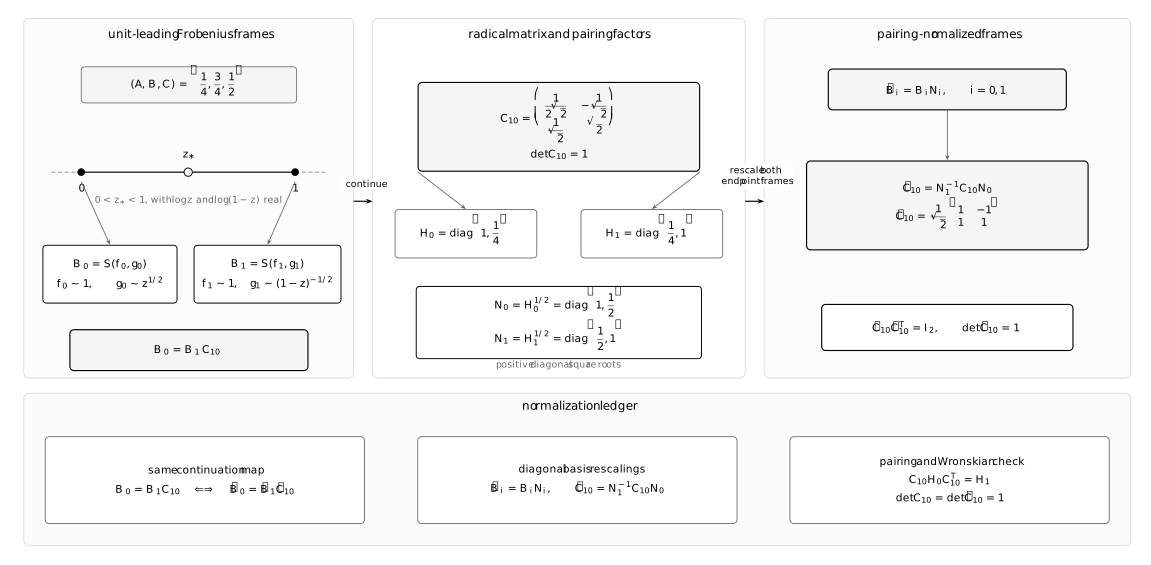
Normalization Conventions: A Four-Point Worked Example
A connection coefficient is not a number until its source and target
bases have been normalized. In CFT language, the same warning applies to
a fusing matrix: unit-leading conformal blocks, normalized chiral vertex
operators, and a full correlator carry different diagonal factors.
This chapter-closing example makes every factor visible. We choose a
nonresonant four-point BPZ problem whose Gauss parameters are
(1/4,3/4,1/2). The four gamma quotients reduce to radicals, the
solutions admit an elementary trigonometric check, and a diagonal
pairing normalization turns the unit-leading connection matrix into a
signed Hadamard rotation.
and use centered Liouville momenta
aL,i=αi−QL/2. Choose
baL,0baL,1baL,∞=−41,=41,=41.
In uncentered variables,
α0α1=α∞=2QL−4b1,=2QL+4b1=QL−α0.
All three nondegenerate background weights are equal:
Δe:=Δ0=Δ1=Δ∞=4QL2−16b21.
The light degenerate insertion is V−b/2, with
Δd=−21−43b2.
The reflected momenta are deliberate. The differential equation sees
aL,i2, hence only the weights. A normalized Liouville
field also remembers the reflection relation between
Vα and VQL−α, including its nontrivial
reflection amplitude.
This slice is nonresonant. Its three oriented exponent differences will
be
1−C=21,C−A−B=−21,A−B=−21.
None is an integer, so all three singular points admit ordinary
two-column Frobenius frames.
The raw local powers follow from the centered-momentum rule
ρi,ϵ=2bQL+ϵbaL,i,ϵ=±1.
For the chosen momenta they are
Point
+ branch
− branch
z=0
(2b2+1)/4
(2b2+3)/4
z=1
(2b2+3)/4
(2b2+1)/4
z=∞
ν∞,+=−b2−1/4
ν∞,−=−b2−3/4
At infinity the convention is
B(z)∼z−ν∞,ϵ. The finite-point branch
labels encode the two degenerate fusion rules:
z=0z=1+α0−2bα1−2b−α0+2bα1+2b.
Thus the + label means the minus momentum shift. It does not mean
“the larger exponent”: at zero it is the smaller power, while at one it
is the larger power.
Because S(z)/zρ0,+→1 at zero and
S(z)/(1−z)ρ1,+→1 at one, the shared gauge is unit-leading
at both endpoints. No hidden diagonal matrix enters this particular
Gauss-to-BPZ step.
Transposing C10 would describe the scalar-coefficient convention
with source labels on rows. It would not describe the declared
right-acting row-frame relation.
This verifies all four radical coefficients without gamma algebra.
Analytic continuation then extends the equality from the interval to
the chosen cut plane.
Wronskians fix the determinant before simplification
For the Gauss frames, Abel’s identity and the unit-leading endpoint
coefficients give
Wr[f0,g0]=21z−1/2(1−z)−3/2,
and
Wr[f1,g1]=21z−1/2(1−z)−3/2.
Because (f0,g0)=(f1,g1)C10,
Wr[f0,g0]=det(C10)Wr[f1,g1].
The Wronskians therefore force detC10=1 before any gamma
function is evaluated. This agrees with the generic centered-momentum
check
detC10=−aL,1aL,0=1.
Multiplication by the shared scalar gauge multiplies each Wronskian by
S(z)2. Hence the raw BPZ frames obey
Wr[B0,+,B0,−]=Wr[B1,+,B1,−]=21[z(1−z)]b2.
This is also the direct Abel solution of the specialized BPZ equation.
It checks the raw powers, scalar gauge, basis order, and matrix direction
at once.
Pairing normalization turns the matrix into a rotation
The unit-leading matrix is not orthogonal. That is not a defect:
orthogonality refers to a chosen pairing, not to Frobenius leading
coefficients.
For real b>0, pair antiholomorphic blocks by complex conjugation and
choose, up to an overall positive scalar,
H0=(10041).
The connection relation requires
H1=C10H0C10T=(41001).
Both matrices are diagonal in their local channel. The resulting
monodromy-invariant analytic completion can be written in either frame:
∣B0,+∣2+41∣B0,−∣2=41∣B1,+∣2+∣B1,−∣2.
Now take the positive square roots
N0=diag(1,21),N1=diag(21,1),
and define pairing-normalized frames
Bi=BiNi.
Their connection matrix is
C10=N1−1C10N0=21(11−11).
Thus
C10C10T=I,detC10=1.
The nonorthogonal radical matrix and the orthogonal signed-Hadamard rotation
encode the same analytic continuation map in two different
normalizations.
We therefore call C10 a pairing-normalized connection
matrix. It becomes a particular degenerate CFT fusing matrix only if
the factors Ni=Hi1/2 are also adopted as the chiral-vertex
normalization; a physical theory need not make that choice.
The unit-leading matrix has detC10=1 but is not orthogonal.
Diagonal rescalings by N0 and N1 preserve the continuation map and
produce the pairing-normalized rotation
C10=N1−1C10N0.
For arbitrary invertible diagonal matrices Di, set
Bi=BiDi.
Then
C10=D1−1C10D0,
while a fixed full pairing is represented by
Hi=Di−1Hi(Di−1)†.
Its determinant changes as
detC10=detD1detD0detC10.
Therefore neither the individual entries nor the determinant of a
connection matrix are invariant under independent source and target
normalizations. Monodromy conjugacy classes, a fully normalized pairing,
or a complete boundary observable are the appropriate invariant
objects.
The acronym DOZZ denotes the
Dorn–Otto–Zamolodchikov–Zamolodchikov three-point structure constants.
The complete record is:
Layer
Data fixed here
Remaining convention or input
Gauss ODE
Unit-leading functions and cut plane
None within the declared branch domain
Raw BPZ block
Shared scalar gauge S(z), branch order, and inherited field-at-infinity convention
None within the declared CFT convention
Chiral vertex block
Covariance law C10=D1−1C10D0
Actual diagonal Di and three-point chiral-vertex normalization
Analytic full pairing
Complex conjugation and the relative matrices H0,H1
One common positive scalar
Physical Liouville correlator
Not fixed
Spectrum, DOZZ coefficients, reflection amplitude, and integration or summation prescription
In particular, the equality
α1=QL−α0 does not identify the corresponding
normalized Liouville fields with coefficient one. The ODE cannot recover
that reflection coefficient because it depends only on the equal
weights.
The example also avoids resonance by design. If C or C−A−B becomes
an integer, the displayed unit-leading pair degenerates and gamma poles
must be combined with a singular basis change before taking the limit.
The finite result is a Frobenius–logarithmic frame. A pole of a gamma
factor by itself is not evidence that the solution space diverges, and a
reciprocal-gamma zero can instead signal truncation or reducibility.
Quoting the matrix without its direction. Here
B0=B1C10.
Changing to column frames, scalar coefficient arrays, or the inverse
continuation changes the displayed matrix.
Forgetting the branch order. Rows are the (+,−) branches at one;
columns are the (+,−) branches at zero. The + sign labels the
momentum shift αi−b/2, not a globally larger exponent.
Calling the unit-leading matrix a normalized fusing matrix. It is a
perfectly normalized ODE connection matrix. A chosen CFT chiral-vertex
normalization can still multiply its rows and columns diagonally.
Demanding orthogonality before choosing a pairing. Frobenius
normalization fixes leading coefficients, not inner products.
Orthogonality appears only after the explicit Hi normalization.
Treating reflection as literal equality of fields. Reflected
momenta have equal conformal weights, so they give the same BPZ
coefficient. Their physical Liouville fields differ by a
normalization-dependent reflection amplitude.
Substituting resonant parameters into the generic gamma matrix.
Gamma poles then diagnose a degenerating basis. Construct the logarithmic
basis first and only then take the limit.
A. A. Belavin, A. M. Polyakov, and A. B. Zamolodchikov,
“Infinite Conformal Symmetry in Two-Dimensional Quantum Field
Theory”,
Nuclear Physics B241 (1984), 333–380. Equations
(5.17)–(5.24) derive the second-order null-vector equation, its
four-point Riemann form, and the two fusion branches.
G. Bonelli, C. Iossa, D. Panea Lichtig, and A. Tanzini,
“Irregular Liouville Correlators and Connection Formulae for Heun
Functions”,
Communications in Mathematical Physics397 (2023), 635–727.
Equations (2.1.1)–(2.1.7) give the centered-momentum BPZ equation,
hypergeometric solutions, full pairing, and gamma matrix used here.
J. Teschner,
“Liouville Theory
Revisited”,
Classical and Quantum Gravity18 (2001), R153–R222. Equations
(209), (222), (224), and (231)–(252) distinguish chiral-vertex
normalizations, fusion transformations, and full-correlator crossing.
NIST Digital Library of Mathematical Functions,
§15.10, especially equations
15.10.1–15.10.5 and 15.10.21–15.10.22, for the Gauss equation,
canonical bases, Wronskians, and connection coefficients.
NIST Digital Library of Mathematical Functions,
§15.4, especially equations
15.4.12, 15.4.14, 15.4.16, and 15.4.18, for the elementary
trigonometric reductions used in the independent check.