
The Heavy–Light Classical Limit
The classical limit used for the CFT–ODE dictionary is a coordinated double scaling, not the instruction “make the central charge large.” The four background primaries and the selected intermediate channel become heavy, with weights of order , while the degenerate insertion stays light, with weight of order one. The heavy part exponentiates into a classical four-point block; the light part survives as a probe wavefunction whose two degenerate fusion branches span a two-dimensional local solution space.
That factorization supplies the missing step in the five-insertion BPZ equation. The modulus derivative is not discarded. Acting on the heavy exponential, it becomes multiplication by a -independent accessory residue. Only its action on the finite probe factor is subleading.
Central charge and weights must scale together
Section titled “Central charge and weights must scale together”For the simplest real reading, take . For complex , fix a sector and an asymptotic branch; then diverges in magnitude rather than approaching in an ordered sense.
With
one has the exact expansion
Thus implies , but that alone does not specify a classical block. The external and internal weights must scale so that their ratios to remain finite.
For every heavy label
use the centered momentum from the guide conventions and choose
Since ,
More generally, gives the same leading result. In the uncentered momentum, write . Then
Alternatively, the exact finite- lift gives
Holding exactly fixed and holding exactly fixed are two different finite- lifts with the same leading . The leading oper is insensitive to that distinction; its first correction need not be. The centered lift is especially useful here because it exposes the ODE exponent difference immediately.
The chosen degenerate field really is light
Section titled “The chosen degenerate field really is light”A convenient fixed-weight light representative has uncentered momentum
or by its reflection . Its weight is
By contrast, holding a generic uncentered momentum gives . That is small relative to , but it is not the fixed-weight light scaling used here.
For the guide’s presentation,
and
Its weight remains finite while the background weights grow as . Its null relation,
is precisely the presentation whose BPZ equation retains a finite second derivative after multiplication by .
The dual degenerate field behaves differently in this same limit:
It is heavy, and its null relation contains . It becomes the light presentation only after the dual exchange ; the Kac label alone does not license swapping the two fields.
Fusion powers become oper exponents
Section titled “Fusion powers become oper exponents”The finite- fusion power adjacent to a heavy insertion is
Under the centered heavy scaling,
This agrees with the indicial equation of a normal-form oper having double-pole coefficient :
The CFT fusion branches therefore become the two local Frobenius powers of the limiting ODE. This is an independent check of both the sign in and the branch order fixed on the degenerate-fusion page.
A classical block is a logarithmic limit
Section titled “A classical block is a logarithmic limit”Fix the channel, the internal heavy weight, the branch of , and the normalization of the four-point chiral block . Its classical block is defined by
when this limit exists on the chosen branch. At minimum, the definition implies
On a regular generic semiclassical branch one often has the stronger expansion
This sign convention is a definition. Sources that write use the opposite leading convention, , because . Exponentiation of a generic four-heavy block is established independently of the mixed degenerate probe. The five-point factorization used below is a selected-branch semiclassical statement, explicitly realized in the references, rather than a theorem of global uniformity over the entire -plane.
Recall the exact normalization
Define the normalized classical block by
On the declared branch of ,
Consequently,
This elementary shift is why an accessory formula is meaningless until the OPE prefactor has been stated.
The first sewing coefficient checks the scaling
Section titled “The first sewing coefficient checks the scaling”The level-one coefficient derived on the Virasoro-block page gives
where
Indeed, the quantum level-one coefficient grows as . At higher levels the claim is much stronger: powers more singular than must cancel in the logarithm of the block. Semiclassical exponentiation is this nontrivial reorganization, not a termwise replacement of every weight by .
The degenerate insertion factors off the heavy background
Section titled “The degenerate insertion factors off the heavy background”Choose one local degenerate branch and compatible chiral-vertex normalizations for the five-point block and the background four-point block. The heavy–light statement is that their ratio has a finite leading limit,
Write the exact ratio as . The required statement is . When a regular even-power expansion exists, this refines to . The heavy exponential remains entirely inside , including any finite -independent correction .
On compact probe domains away from the punctures, assume that locally uniformly in . Holomorphy then gives convergence of its first two -derivatives. In the modulus direction, the reduction below requires
Pointwise convergence of alone does not imply the first derivative limit.
A vanishing momentum shift can leave a finite factor
Section titled “A vanishing momentum shift can leave a finite factor”In a branch in which the degenerate probe fuses with the insertion at ,
For the scaled exponent difference this is
Although the shift vanishes as , it occurs inside an exponential of order :
This is one contribution to the normalization of . Local-coordinate powers and chiral-vertex conventions supply others. The leading oper needs only , but connection coefficients can remember these finite momentum derivatives.
Power counting turns the BPZ PDE into an oper
Section titled “Power counting turns the BPZ PDE into an oper”Write the exact finite- equation derived on the BPZ-equations page as
where
and
Multiply the equation by and insert the derivative-compatible factorization . After division by , the exact rescaled equation is
Every contribution now has an unambiguous order:
| Contribution after multiplication by | Leading action on the factorized block | Order |
|---|---|---|
| Heavy weights give the classical pole potential | ||
| on | ||
| on | ; under the regular expansion | |
| The light weight inside |
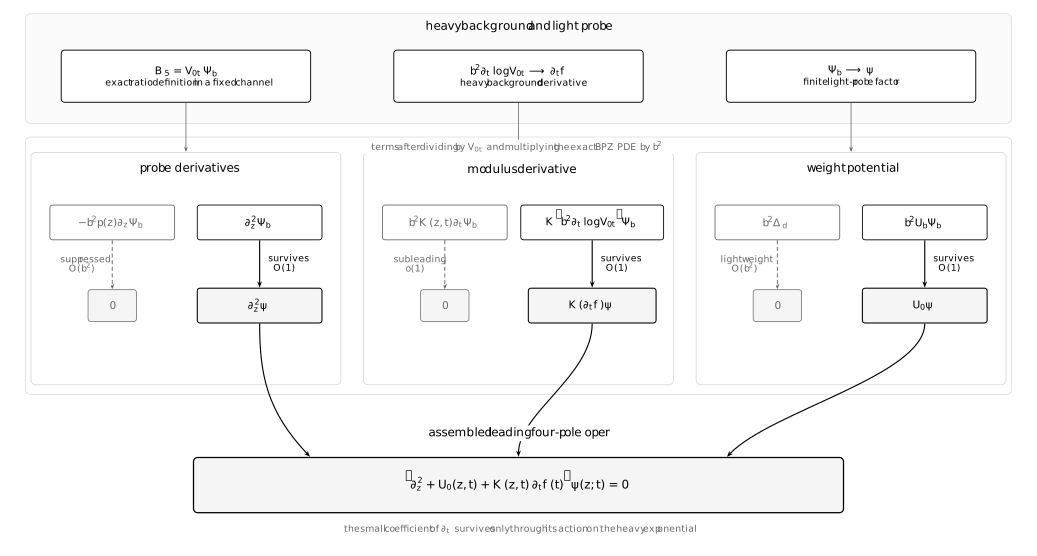
Defining the finite- ratio separates the heavy block from the probe before the limit is taken. Here is the classical pole potential; only the three solid lanes assemble the leading oper.
The modulus derivative survives at leading order through . What disappears is only its action on the finite probe factor. The leading equation is
with
where, for the unhatted block convention on this page,
For the hatted block,
The next page will compare this fixed-coordinate oper residue with other classical-block and standard-Heun accessory conventions. No such crosswalk should be inferred from the symbol “accessory” alone.
What the limiting statement does and does not guarantee
Section titled “What the limiting statement does and does not guarantee”The derivation is local in parameter space. A safe version fixes:
- a channel, internal weight, branch of , and branch of the classical block;
- away from , , and ;
- in compact subsets away from , , , and ;
- a domain avoiding zeros of the chosen block when its logarithm is used;
- generic weights away from singular Kac or resonant limits;
- a derivative-compatible asymptotic expansion in one sector of the -plane.
Near a collision divisor, a -dependent boundary-layer scaling can change the power counting. Analytic continuation in can also exchange classical saddles or branches. Such saddle walls are not automatically the Stokes curves of an irregular ODE.
The internal weight of a fixed chiral block remains prescribed; no saddle over that weight is being taken. An internal-momentum saddle belongs instead to a full correlator after its structure constants, antiholomorphic pairing, and integration contour have been supplied.
For each fixed admissible , solves an ODE in and may still depend parametrically on . Its modulus-derivative contribution is subleading; under the regular even-power expansion above, it enters two orders later. At every nonzero , the original five-point equation remains a PDE.
Common pitfalls
Section titled “Common pitfalls”Taking only . A classical block requires the external and selected internal weights to scale with . Keeping them fixed defines a different large-central-charge regime.
Calling both degenerate presentations light. Under , is light and is heavy. They are exchanged only with the simultaneous duality .
Deleting the modulus derivative. The term acts at order one on the heavy exponential. Only its action on the probe factor is suppressed.
Dropping the OPE prefactor silently. The hatted and unhatted classical blocks differ by an explicit logarithm, so their derivatives differ by a simple pole.
Ignoring a vanishing shift inside the exponent. A momentum shift of order changes by order one. Such terms affect normalized probe solutions and later connection coefficients.
Treating a local asymptotic as a global identity. The classical block has channel and analytic branches, and a fixed saddle need not dominate after arbitrary continuation in .
Exercises
Section titled “Exercises”1. Separate the light and dual-degenerate weights
Section titled “1. Separate the light and dual-degenerate weights”Expand , , and as . Which degenerate field is light?
Solution
Direct substitution gives
Thus has finite weight and is the light probe in this limit. The dual field has a weight of the same order as the heavy background.
2. Recover the oper coefficient and exponents
Section titled “2. Recover the oper coefficient and exponents”Let . Derive and the two limiting fusion powers.
Solution
The heavy weight is
so
The two fusion powers are
They solve , as required by the normal-form oper.
3. Take the classical limit of the level-one coefficient
Section titled “3. Take the classical limit of the level-one coefficient”Use the exact level-one sewing coefficient to recover in the small- expansion of .
Solution
Substitute into
The result is
with
Since , its coefficient of gives .
4. Check the OPE-prefactor shift
Section titled “4. Check the OPE-prefactor shift”Starting from , derive the relation between the two classical accessory derivatives.
Solution
Take a logarithm, multiply by , and pass to the heavy limit:
Therefore
The difference is fixed and explicit, but only after the branch of and the block normalization have been declared.
5. Keep the correct part of the modulus derivative
Section titled “5. Keep the correct part of the modulus derivative”Under the regular ansatz , compute through relative order .
Solution
Differentiation gives
The first term survives and generates the accessory contribution. The derivative is subleading; setting the whole modulus derivative to zero would remove the leading term as well.
6. Extract a finite factor from a vanishing fusion shift
Section titled “6. Extract a finite factor from a vanishing fusion shift”Show that produces a finite exponential factor in a classical block.
Solution
Taylor expansion gives
Dividing the corresponding block by the unshifted block yields
The shift is invisible in the leading heavy weight but remains in the finite normalization of the probe solution.
7. Identify where the reduction is nonuniform
Section titled “7. Identify where the reduction is nonuniform”Give three situations in which the fixed-, fixed- power counting does not by itself justify the limiting oper.
Solution
Examples include:
- approaches , , , or on a -dependent scale, so derivative and pole terms can rebalance.
- approaches a degeneration point , , or , requiring a separate collision or matched limit.
- Analytic continuation crosses a classical saddle or branch wall, so the selected exponent no longer describes the same asymptotic contribution.
Resonant or Kac-degenerate parameter limits also require coordinated basis limits. None of these effects changes the exact finite- PDE; they restrict where the displayed asymptotic reduction is uniform.
8. Show why pointwise exponentiation is insufficient
Section titled “8. Show why pointwise exponentiation is insufficient”Consider a family defined locally by
Show that pointwise while the scaled logarithmic derivative need not converge.
Solution
Multiplication by gives
However,
and the oscillating term has no limit for generic fixed . The PDE-to-oper reduction therefore needs convergence of the scaled logarithmic derivative, or sufficient locally uniform derivative bounds, not only pointwise convergence of the logarithm.
References
Section titled “References”- A. A. Belavin, A. M. Polyakov, and A. B. Zamolodchikov, “Infinite Conformal Symmetry in Two-Dimensional Quantum Field Theory”, Nuclear Physics B 241 (1984), 333–380. Level-two null-vector decoupling and BPZ equations.
- M. Beşken, S. Datta, and P. Kraus, “Semi-Classical Virasoro Blocks: Proof of Exponentiation”, Journal of High Energy Physics 2020 (2020), 109. Direct exponentiation of Virasoro blocks with heavy external and exchanged weights.
- A. Litvinov, S. Lukyanov, N. Nekrasov, and A. Zamolodchikov, “Classical Conformal Blocks and Painlevé VI”, Journal of High Energy Physics 2014 (2014), 144. Degenerate-probe factorization, accessory derivatives, and the classical monodromy problem. Its Kac labels are interchanged relative to the convention in this guide; the light field is identified by its null relation and weight.
- D. Harlow, J. Maltz, and E. Witten, “Analytic Continuation of Liouville Theory”, Journal of High Energy Physics 2011 (2011), 071. Heavy and fixed-weight light momentum scalings, complex saddles, and continuation-sector caveats.
- M. Piątek and A. R. Pietrykowski, “Solving Heun’s Equation Using Conformal Blocks”, Nuclear Physics B 938 (2019), 543–570. Heavy–light factorization of five-point degenerate blocks and the Heun reduction.
- J. Teschner, “Classical Conformal Blocks and Isomonodromic Deformations”, 2017. Classical asymptotics, branches, and the Garnier/isomonodromic interpretation.
- G. Bonelli, C. Iossa, D. Panea Lichtig, and A. Tanzini, “Irregular Liouville Correlators and Connection Formulae for Heun Functions”, Communications in Mathematical Physics 397 (2023), 635–727. Normalization-aware semiclassical blocks, BPZ-to-Heun reduction, and finite momentum-derivative factors.