
Comparison with Exact WKB and NS Periods
Page 6 ends with a numerical pseudoenergy and an evidence record. Neither is yet a WKB or Nekrasov–Shatashvili period. The same phrase—quantum period—is often attached to four different objects: a formal WKB cycle integral, its directional Borel sum, the logarithm of a TBA -function, and a derivative of an NS free energy. They can describe the same analytic coordinate in important examples, but only after their operator, cycle, normalization, flat coordinate, and chamber data have been matched. A numerical agreement without that specification is not evidence for a new correspondence.
This page turns the bridges proved earlier into a comparison protocol. The TBA–WKB lane is available, for example, in the minimal polynomial chambers of Page 4. The WKB–NS lane is available for specified quantum Seiberg–Witten curves such as the calibrated pure- modified-Mathieu operator of Chapter 10. These two facts do not imply that every TBA has an NS interpretation, or even that the two named lanes close on the same model. Page 8 will apply the protocol to a controlled example.
Quantum-period labels hide six typed outputs
Section titled “Quantum-period labels hide six typed outputs”Type-check the objects before comparing their values.
| Construction | Natural output | Mathematical type |
|---|---|---|
| TBA or NLIE | or | Dimensionless logarithmic or multiplicative coordinate |
| Formal WKB | Formal additive action | |
| Exact WKB | Sectorial additive action | |
| Voros | and | Dimensionless exponent and multiplicative coordinate |
| NS geometry | and | Polarized flat coordinates in a declared scheme |
| Spectral problem | or | Boundary-dependent analytic function |
For a scalar quantum curve in the guide’s normal form, let
be the regularized half branch-difference WKB form, with . An oriented closed cycle carries the formal additive period
its directional or lateral sum
and the multiplicative Voros coordinate
The additive period retains an integer logarithm lift; the Voros coordinate does not. Reversing the cycle inverts the latter and negates the former.
This is a closed-cycle Voros coordinate. An open-path Voros symbol instead contains a regularized integral from one local normalization sector to another and encodes connection data. It cannot be replaced by for some closed merely because both objects undergo Stokes jumps.
A TBA solution instead returns pseudoenergies and -functions,
This expression is not yet a WKB period. It becomes one only when a model-specific theorem or derivation identifies with the same Voros coordinate on a declared ray.
The NS construction supplies another kind of output. In the rank-one normalization of Chapter 10,
It is a derivative in a flat quantum coordinate and a chosen local scheme. It is not the value of the free energy, not a pseudoenergy, and not automatically a spectral condition.
Match the spectral problem across both correspondences
Section titled “Match the spectral problem across both correspondences”Before comparing any pair, freeze the following record.
| Entry | Question that must have one answer |
|---|---|
| Operator | Which polarization, ordering, subprincipal term, gauge, and wavefunction bundle define the quantum curve? |
| Deformation | How are the ODE parameter, TBA rapidity, WKB , and gauge related, including phase? |
| Modulus | Is the operator energy equal to , a rescaling of it, or shifted by contacts? |
| Period form | Is the integrand the half branch difference, and how are poles, endpoints, and amplitude winding regularized? |
| Cycle | What is the oriented homology class, its intersection pairing, and its Gauss–Manin continuation path? |
| Node–charge map | Which TBA node represents that oriented cycle, and has a decaying charge reversal been made? |
| Normalization | Where do , , and powers of enter the additive and multiplicative coordinates? |
| Analytic lane | Which Borel direction, lateral side, logarithm lift, contour bank, and Stokes chamber are used? |
| Flat coordinate | Is the comparison made after solving the quantum mirror map ? |
| Gauge scheme | Which perturbative subtraction, mass convention, Abelian factor, and quadratic counterterm define ? |
| Observable | Are the objects additive periods, exponentials, connection data, or roots of a complete determinant? |
The node label , the cycle label , and the gauge coordinate are unrelated symbols until this table supplies their maps. Dimensional analysis and the classical limit should be checked before any high-precision calculation.
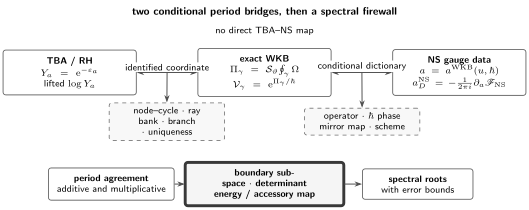
The comparison has two conditional edges. TBA data reach exact WKB only through the node–cycle, ray, branch, and uniqueness specification; exact WKB reaches NS data only through the quantum-curve, mirror-map, and scheme specification. There is no universal primitive TBA–NS edge, and even a closed period comparison does not cross the spectral firewall by itself.
A TBA period is a lifted logarithm of Y
Section titled “A TBA period is a lifted logarithm of Y”Assume the Page 4 gates have identified one TBA coordinate with a directional Voros symbol for a decaying charge :
Taking the transported logarithm gives the additive extraction formula
where is constant until a declared logarithm event is crossed. This formula is exact within that identified analytic problem; it is not a definition that can be imposed on an unrelated TBA.
In the minimal polynomial calibration, parity also chooses the ray:
with the odd nodes evaluated on the declared lateral banks. Comparing all nodes at the same real positive would silently rotate half of the Borel directions.
The exact source dictionary is stronger than a large- fit. In the Ito–Mariño–Shu convention, before the Page 4 cycle and bank translations, it reads
Their cycles obey
Page 4 translates this package by , , and the IMS-to-guide lateral involution. Only after all three operations does it become the compact formula used here. The exact shifted formula reconstructs the sectorial function; the moments below recover only its formal coefficients.
For an even node on the unshifted positive ray, suppose the oriented period has the formal expansion
On an unshifted positive ray with , the large-rapidity expansion is
Thus the drive checks the oriented classical action, while the decaying tail contains the formal quantum corrections. For example,
At finite cutoff, fit several predicted powers and repeat the fit while varying the window, grid, precision, and subtraction. Odd nodes must be fit in the complex variable , not by copying the even-node signs.
Weighted moments avoid subtracting the drive
Section titled “Weighted moments avoid subtracting the drive”For the minimal equation, set
Assume the declared minimal chamber has no crossed kernel pole, the fixed logarithm branch has no divisor on the contour, and is bounded at and sufficiently fast-decaying at . Through the desired order, require finite controlled exponential moments of . Splitting the integral into a region well below and the superexponentially small driven right tail then justifies termwise use of the large- kernel expansion, and gives
where
This follows from expanding in odd decaying exponentials and controlling the complementary integration tail. It is usually more stable than fitting the tiny pointwise difference .
Write . For an even node, and the decaying-charge period is
For an odd node, and the transported lateral period is
These phase formulas use the Page 4 decaying-charge convention. Returning to its original IMS cycles reverses the charge and changes the printed period convention as a package. For complex solutions, require uniform absolute moment bounds on the chosen banks. The two laterals share the same formal coefficients, but finite analytic values use the declared bank; Page 4’s convention involution sends the guide’s to IMS . Their average is not taken unless a median prescription is separately declared.
If bounds the nonlinear-log error, then the propagated moment error satisfies
The last two terms bound the weighted quadrature and finite-precision accumulation. They become increasingly important because the exponential weight amplifies the right side of the numerical window as grows.
Folded quartic equations and general RH kernels require their own kernel expansion; this moment formula is not universal.
Finite-parameter comparisons need two residuals
Section titled “Finite-parameter comparisons need two residuals”Let be obtained by Borel–Padé or another justified directional summation on the same cycle and ray. Once the logarithm lift is frozen, an additive discrepancy is
The branch-invariant multiplicative discrepancy is
A small with a large additive mismatch usually signals a missing , not a failure of the analytic coordinate. Conversely, additive agreement on one branch tests more information than exponentiated agreement.
Page 6’s forward bound propagates directly. If and are fixed and the pseudoenergy error is at most , then
For an odd-node lateral value, add the independently bounded analytic reconstruction and bank-displacement errors. A wrong node–cycle map, phase, or chamber fails the categorical specification; it is not an additional small .
If the independent WKB sum has error , a claimed disagreement requires
Below that combined floor, the calculation is inconclusive. The same principle applies to the multiplicative residual after propagating the exponential condition number.
Borel–Padé must sum the same typed object
Section titled “Borel–Padé must sum the same typed object”Generate the WKB coefficients independently of the TBA moments. For
define the quantum part of its formal Voros exponent by
The additive period tail and use different shifted Borel transforms:
Choose the transform for the object actually compared, build several near-diagonal Padé approximants at guard precision, and integrate on the same ray and lateral side encoded by the TBA bank. Vary coefficient order, Padé shape, ray offset, and Laplace quadrature. Equality of several formal coefficients remains weaker than equality of sectorial functions: terms can share the entire power-series asymptotic expansion while changing the analytic answer.
Ito–Mariño–Shu print an equivalent unshifted convention for the full even series,
The factorial shift is tied to whether the classical term and the outside are included. Mixing the coefficients from one convention with the Laplace integral of the other changes the answer.
The NS comparison is made at fixed quantum A-period
Section titled “The NS comparison is made at fixed quantum A-period”Choose a transported symplectic basis with and define
Where , solve the local quantum mirror map
Only then is the normalization-complete candidate comparison
The symbol means conditional equality in the recorded model-specific specification. Comparing the two sides at the same printed classical generally compares different coordinates. Near a zero of , inversion is ill-conditioned and a new flat-coordinate patch or symplectic frame is required.
Formal matching compares coefficients in and, when appropriate, the gauge coupling. Analytic matching additionally needs compatible resummation, logarithm, and continuation data. A convergent instanton series in one gauge chamber does not by itself prescribe a WKB lateral sum across a Stokes wall.
Established examples occupy different edges
Section titled “Established examples occupy different edges”The guide has not established one universal three-way example.
| Example | Established comparison | What remains outside the claim |
|---|---|---|
| Polynomial Schrödinger equation with simple ordered turning points in its minimal chamber | TBA/Wronskian coordinate ↔ resummed WKB period after the complete Page 4 specification | Universal ODE/IM–GMN equivalence, NS dictionary, and spectrum |
| Pure quartic in the frozen symmetry-reduced chamber | Folded equation-level TBA ↔ exact-WKB reduction in the stated chart | Global complex uniqueness and an NS dictionary |
| Pure- modified Mathieu | Formal WKB ↔ NS periods through the orders checked in Chapter 10; published chamber-sensitive analytic evidence | A TBA arrow or chamber-independent analytic equality |
| Homogeneous radial ODE/IM problem | Normalized ODE spectral determinant ↔ BLZ -eigenvalue for the declared module state | Equality with a WKB or NS period |
| Arbitrary TBA and arbitrary NS theory | No map | Every comparison edge |
Keep the rotation phase of an ODE/IM functional relation separate from the instanton fugacity . Their common letter in parts of the literature is not a dictionary.
The homogeneous anharmonic-oscillator lane needs a separate historical qualification. Dorey–Tateo define a zeta-regularized spectral determinant, whose zeros are spectral levels after a sign change, and derive an exact quartic determinant functional relation. Their 1999 extension to the massless system for general is presented as a conjectural identification supported by numerical checks. Neither output is a WKB period before a further model-specific dictionary is supplied.
Scheme and frame changes are visible, not errors
Section titled “Scheme and frame changes are visible, not errors”A finite local counterterm
shifts the dual coordinate by
The constant disappears, but the affine shift does not. It must be calibrated from the classical dual asymptotic, perturbative logarithm, or a declared frame convention rather than fitted away after seeing the answer.
Likewise, for a rank-one symplectic change
the WKB and NS period vectors must both transform by the same . Agreement of one component before the frame change is not supposed to survive if only one lane is transformed.
For the shear ,
The NS definition produces the same shift from the coordinated counterterm . Frame and scheme changes therefore move together.
Lateral jumps are part of the comparison
Section titled “Lateral jumps are part of the comparison”Across a simple type-I WKB wall of active cycle , the guide’s fixed-lattice convention gives
After a logarithm lift is chosen, the additive discontinuity is
An identified TBA or RH construction must reproduce the same jump with the same intersection sign, lower lateral input, and transported lattice. On the NS lane, a local formal derivative does not automatically contain this analytic completion. One must specify the resummation or nonperturbative completion being compared. Averaging two laterals is an additional median prescription, not a neutral default.
This formula is not a blanket theorem for every Stokes graph. The regular-saddle result of Iwaki–Nakanishi assumes, among other conditions, a compact base, simple turning points, poles of order at least two with controlled lower potential terms, one regular saddle trajectory, and saddle-free reductions on its two sides; the Borel-sum statement is made for sufficiently large positive exact-WKB parameter after rotating to their phase convention, equivalently large in the compatible decay sector. Their degenerate-saddle formula contains instead, and its closed-cycle symbols do not jump. The graph type must therefore be classified before copying a DDP factor.
A period triangle closes only after both edges close
Section titled “A period triangle closes only after both edges close”There are two legitimate workflows.
- TBA versus WKB. Solve the Page 6 equation, reconstruct the declared , and compare it with a separately Borel-summed WKB period on the same cycle and ray.
- WKB versus NS. Construct the quantum mirror map, calibrate the gauge scheme, and compare the WKB dual period with the NS derivative at fixed .
A TBA–NS number is meaningful only when both workflows refer to the same operator and the same analytic coordinate. If the first uses a quartic oscillator while the second uses the pure- modified-Mathieu curve, their separate successes do not form a triangle.
Even a closed period triangle stops at a spectral firewall. A spectrum requires a boundary subspace, a determinant or complete exact quantization condition, and a common energy map. Neither nor equals a quantization condition merely because it appears inside one in a named problem.
A comparison manifest makes disagreements diagnosable
Section titled “A comparison manifest makes disagreements diagnosable”For every reported value, store
Then report the following checks separately.
| Symptom | First diagnostic |
|---|---|
| Wrong classical limit | Cycle orientation, one-form factor, or energy rescaling |
| Correct leading action, wrong term | Ordering, subprincipal term, amplitude winding, or quantum modulus shift |
| Additive mismatch by | Logarithm lift or continuation history |
| Exponentials agree but dual periods drift affinely | NS counterterm or symplectic frame |
| Even nodes agree, odd nodes do not | Missing ray rotation or wrong lateral bank |
| Agreement at fixed fails after instanton corrections | Quantum mirror map omitted or inverted on the wrong branch |
| Jump has the correct factor but inverse power | Cycle intersection or upper/lower convention reversed |
| Difference shrinks with the nonlinear tolerance and then stalls | Tail, quadrature, WKB summation, or NS truncation floor |
| Periods agree but levels do not | Boundary determinant, domain, or energy/accessory map differs |
Refine TBA, WKB, and NS computations independently. Shared coefficients or code paths are useful for speed but do not constitute an independent check.
Common pitfalls
Section titled “Common pitfalls”Declaring a TBA pseudoenergy to be a period by notation. The map follows from an identified Voros coordinate and a transported logarithm. Without that bridge it is only a relabeling.
Comparing the NS derivative at fixed classical modulus. The NS dual coordinate is a function of the flat quantum A-period. Invert the mirror map before evaluating the WKB B-period.
Using exponentials to hide an unexplained additive mismatch. A Voros ratio correctly removes a known logarithm lattice, but the integer must still be recorded if additive periods are claimed.
Averaging laterals without naming the prescription. Upper, lower, and median sums are different analytic objects on a singular direction.
Turning period agreement into a spectrum. A boundary determinant and energy dictionary remain independent data.
Exercises
Section titled “Exercises”1. Lift a TBA logarithm. Suppose an established dictionary gives with and . Recover the most general additive period and explain when its integer can change.
Solution
Taking logarithms on transported sheets gives
and hence
The integer is fixed under continuation that avoids a zero or pole of the coordinate and avoids a logarithm cut. It changes only at a declared branch event; choosing a fresh principal logarithm at each parameter value does not define a valid continuation.
2. Read a WKB coefficient from rapidity. Let
and take the zero logarithm lift. Expand through , give a limit for after is known, and express the general even-node as a weighted minimal-chain moment.
Solution
Since ,
After subtracting the drive and the first correction,
Numerically, one replaces the limit by a multi-window fit and includes the Page 6 tail and discretization errors.
For the minimal-chain kernel, , so
This identity requires the fixed chamber and logarithm branch, the weighted integrability stated in the text, and control of the driven right tail when the kernel series is integrated term by term.
3. Separate an additive branch error from a functional error. Two computations give
Compute their Voros-coordinate ratio and state what it tests.
Solution
Exponentiation removes the integer lattice:
Thus the ratio tests the analytic coordinate independently of . If it equals one within errors, the additive mismatch may be only a logarithm lift. The test does not determine which integer is correct.
4. Show why the mirror map cannot be skipped. Suppose
with . Find through order .
Solution
Write
Expanding the defining equation gives
so
Substituting alone into the B-period misses the induced order- term . That is why fixed- and fixed- comparisons differ.
5. Track an NS counterterm. Let
Find the change caused by . Which part is invisible?
Solution
Differentiation gives
The constant is invisible to the period derivative. The quadratic and linear terms produce a genuine affine frame shift and must be matched, not discarded as numerical error.
6. Transport both period vectors. Let
Apply it to and explain how a WKB–NS comparison changes.
Solution
The new frame is
Both the WKB and NS vectors must transform by . If only the WKB cycles are relabeled, comparing with the old mixes different components and should fail.
7. Take the logarithm of a DDP jump. Starting from
derive the additive discontinuity and identify its ambiguity.
Solution
On a transported logarithm branch,
Multiplying by gives the formula in the text. The integer records the logarithm lift; the lower lateral value and intersection sign are fixed by the guide’s DDP convention.
8. Check a proposed three-way match. A calculation compares a quartic oscillator TBA pseudoenergy with a pure- NS derivative. It observes ten matching digits after independently rescaling each result and claims a universal TBA–NS identity. Give four decisive objections.
Solution
First, the two computations have not been shown to quantize the same operator or classical curve. Second, an arbitrary fitted rescaling does not fix the period-form and normalization specification. Third, no node–cycle map or TBA–Voros identification has been established. Fourth, the NS derivative has not been evaluated through a common quantum mirror map and scheme. One must also match phases, cycles, chambers, lateral sides, and numerical error budgets. Decimal agreement after free rescaling cannot replace these gates.
References
Section titled “References”- K. Ito, M. Mariño, and H. Shu, “TBA Equations and Resurgent Quantum Mechanics”, Journal of High Energy Physics 2019 (2019), 228, especially Eqs. (3.3)–(3.14) and (3.30)–(3.43). Derives the minimal-chamber TBA from both resummed periods and Wronskian -functions, with the parity-dependent Borel directions used in the extraction above.
- P. Dorey and R. Tateo, “Anharmonic Oscillators, the Thermodynamic Bethe Ansatz, and Nonlinear Integral Equations”, Journal of Physics A 32 (1999), L419–L425. Derives the exact quartic determinant relation and presents the broader homogeneous ODE/IM–TBA identification with its original conjectural and numerical status.
- K. Iwaki and T. Nakanishi, “Exact WKB Analysis and Cluster Algebras”, Journal of Physics A 47 (2014), 474009. Separates cycle and path Voros symbols and proves the stated simple-wall transformation under its saddle and summability hypotheses.
- N. A. Nekrasov and S. L. Shatashvili, “Quantization of Integrable Systems and Four Dimensional Gauge Theories”, in XVIth International Congress on Mathematical Physics (2010), 265–289. Defines the NS twisted superpotential and its Bethe/gauge interpretation while retaining model and boundary-condition data.
- A. Mironov and A. Morozov, “Nekrasov Functions and Exact Bohr–Sommerfeld Integrals”, Journal of High Energy Physics 2010 (2010), 040. Compares pure- WKB periods and the deformed prepotential coefficientwise; it does not establish a universal Borel-resummed theorem.
- K. Ito, S. Kanno, and T. Okubo, “Quantum Periods and Prepotential in N=2 SU(2) SQCD”, Journal of High Energy Physics 2017 (2017), 065. Computes WKB differential operators and quantum prepotentials for specified matter theories, supporting model-specific formal matching.
- A. Grassi, J. Gu, and M. Mariño, “Non-Perturbative Approaches to the Quantum Seiberg–Witten Curve”, Journal of High Energy Physics 2020 (2020), 106. Compares gauge-resummed and Borel-resummed modified-Mathieu periods and displays the strong-chamber lateral relations that prevent a chamber-free equality claim.
- G. Başar and G. V. Dunne, “Resurgence and the Nekrasov–Shatashvili Limit: Connecting Weak and Strong Coupling in the Mathieu and Lamé Systems”, Journal of High Energy Physics 2015 (2015), 160. Develops the all-orders WKB/Seiberg–Witten relation and shows why exponentially small band and gap widths lie beyond bare all-orders period data.
- A.-K. Kashani-Poor and J. Troost, “Pure N=2 Super Yang–Mills and Exact WKB”, Journal of High Energy Physics 2015 (2015), 160. Derives quantum periods and shows explicitly that exact Floquet monodromy also needs Stokes continuation matrices.
- D. Gaiotto, G. W. Moore, and A. Neitzke, “Wall-Crossing, Hitchin Systems, and the WKB Approximation”, Advances in Mathematics 234 (2013), 239–403. Constructs the WKB/Darboux-coordinate Riemann–Hilbert framework in which chamber data, active charges, and wall-crossing are part of the analytic object.