
Appendix E: Bibliography and Source Map
The page-level reference sections supply detailed sources for the guide’s mathematical and physical claims. This appendix selects routes into that literature, separates historical priority from present-day readability, and identifies which papers establish ODE results and which propose or test a model-dependent dictionary.
No arrow in the source map is licensed by visual proximity. A correspondence is usable only after its operator, parameter map, normalized bases or cycles, analytic domain, and theorem status have been matched.
Four reading labels answer different questions
Section titled “Four reading labels answer different questions”| Label | Question it answers | What it does not imply |
|---|---|---|
| Historical | Where did the object or method enter the literature? | That the source uses modern language or is the best introduction |
| First read | What is the shortest reliable route into the chapter? | That every proof or normalization detail is included |
| Deeper read | Where are the analytic hypotheses and derivations developed? | That the source covers every application in this guide |
| Frontier | Which primary paper carries the method into an active correspondence or application? | That its proposed bridge is universal or fully proved |
“Frontier” is a scope warning as much as a recommendation. Readers should carry the claim labels from How to Use This Guide into every such paper: theorem, derivation, formal identity, conditional exact statement, conjectural correspondence, or numerical observation.
For a version of record, prefer its DOI. Use arXiv when it supplies the open manuscript, source files, ancillary data, or a later corrected version. When formula numbering matters, record the arXiv version or journal edition; “the same paper” can otherwise point to different equations.
Connections between ODEs and other methods
Section titled “Connections between ODEs and other methods”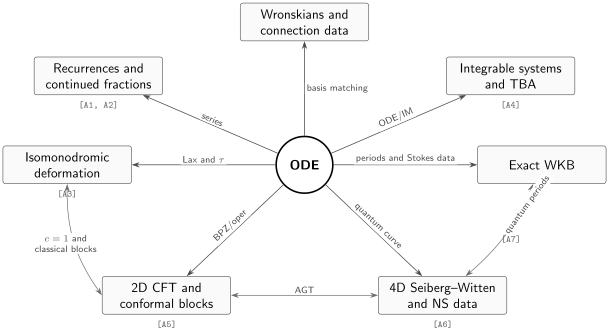
The ODE is the common analytic object. The outer boxes describe analytic data, computational methods, and model-dependent dictionaries. Each arrow states the extra structure needed to relate its endpoints; it does not assert an unconditional equality. Tags [A1]–[A7] identify the primary papers discussed below.
To use a proposed correspondence, identify the underlying operator, its normalized local or asymptotic solutions, and the connection or spectral quantity being computed. Each further identification requires its own parameter dictionary and analytic hypotheses.
Primary papers for the source map
Section titled “Primary papers for the source map”The following papers illustrate recurrence, isomonodromic, conformal-block, gauge-theory, and integrability methods for specified ODE families. Each annotation identifies the paper’s contribution and the limits of its application. Publisher and arXiv links provide the corresponding source.
A1–A2 · Recurrences and Heun connection data
Section titled “A1–A2 · Recurrences and Heun connection data”- [A1] O. Lisovyy and A. Naidiuk, “Perturbative Connection Formulas for Heun Equations”, Journal of Physics A 55 (2022), 434005, doi:10.1088/1751-8121/ac9ba7. Large-order recurrence asymptotics produce perturbative connection amplitudes for general, confluent, and reduced confluent Heun equations. The paper also tests a classical-block proposal; that test should not be relabeled as a universal exact block theorem.
- [A2] J. Ren and Z. Yu, “Holographic Thermal Correlators from Recursions”, Journal of High Energy Physics 06 (2025), 183, doi:10.1007/JHEP06(2025)183. The recurrence method is applied to charged scalar correlators in two specified asymptotically AdS backgrounds. Its agreement with a conformal-block representation is model- and normalization-specific.
A3–A4 · Isomonodromy and ODE/IM–TBA in black-hole problems
Section titled “A3–A4 · Isomonodromy and ODE/IM–TBA in black-hole problems”- [A3] J. Barragán Amado, B. Carneiro da Cunha, and E. Pallante, “Quasinormal Modes of Scalar Fields on Small Reissner–Nordström–AdS Black Holes”, Physical Review D 105 (2022), 044028, doi:10.1103/PhysRevD.105.044028. This is an isomonodromic analysis in the small-horizon and low-temperature regime, with numerical evidence for the resulting modes and instability window; it is not a generic theorem for all AdS black holes.
- [A4] D. Fioravanti and D. Gregori, “New Method for Exact Results on Quasinormal Modes of Black Holes”, Physical Review D 112 (2025), 125020, doi:10.1103/b8pl-vdwy. This short paper formulates functional and TBA equations for its declared gravity systems and compares numerical solutions. Importing those equations to another ODE requires a fresh ODE/IM parameter, analyticity, contour, and boundary-condition analysis.
A5–A7 · Conformal blocks, gauge theory, and quantum periods
Section titled “A5–A7 · Conformal blocks, gauge theory, and quantum periods”- [A5] G. Bonelli, C. Iossa, D. Panea Lichtig, and A. Tanzini, “Irregular Liouville Correlators and Connection Formulae for Heun Functions”, Communications in Mathematical Physics 397 (2023), 635–727, doi:10.1007/s00220-022-04497-5. The paper develops irregular Virasoro blocks and semiclassical Heun connection formulae. Use its full gauge, fusion, branch, and asymptotic conventions rather than identifying a bare block with a unit-leading ODE coefficient.
- [A6] G. Aminov, A. Grassi, and Y. Hatsuda, “Black Hole Quasinormal Modes and Seiberg–Witten Theory”, Annales Henri Poincaré 23 (2022), 1951–1977, doi:10.1007/s00023-021-01137-x. It proposes Nekrasov–Shatashvili quantization conditions for specified black-hole and angular equations and tests them against known numerical data. The paper itself calls the key exact quantization relation a proposal, so numerical success does not turn it into a universal theorem.
- [A7] Y. Lei, H. Shu, K. Zhang, and R.-D. Zhu, “Quasinormal Modes of C-Metric from SCFTs”, Journal of High Energy Physics 02 (2024), 140, doi:10.1007/JHEP02(2024)140. The charged C-metric supplies a concrete four-dimensional SCFT/connection dictionary and several mode families. Its radial and angular maps are valuable calibrations, not templates that bypass equation-by-equation matching.
The original AGT paper supplies the foundational relation between conformal blocks and gauge-theory partition functions used by several of these applications. Read it alongside the model-specific studies to distinguish that relation from the additional steps needed for an ODE connection formula.
- Foundational AGT paper. L. F. Alday, D. Gaiotto, and Y. Tachikawa, “Liouville Correlation Functions from Four-Dimensional Gauge Theories”, Letters in Mathematical Physics 91 (2010), 167–197, doi:10.1007/s11005-010-0369-5. This is the primary entry point for the AGT conjecture identifying the declared Liouville/Toda conformal blocks with Nekrasov partition functions; it presents extensive genus-zero and genus-one tests. It does not, by itself, identify an arbitrary second-order ODE or fix an ODE connection coefficient.
A three-stage route through all fifteen chapters
Section titled “A three-stage route through all fifteen chapters”Each route is deliberately short. “First read” favors orientation, “deeper read” favors foundations and hypotheses, and “research frontier” points to a primary paper where the chapter’s machinery is actively extended or combined with another dictionary. Repeated sources are intentional: the same paper can be a frontier application in one chapter and a foundational input in another.
Part I · Analytic foundations and direct connection methods
Section titled “Part I · Analytic foundations and direct connection methods”Chapter 1 · Complex linear ODEs.
- First read — DLMF §2.7 gives a compact, notation-stable account of regular and irregular singular points and asymptotic solutions.
- Deeper read — H. L. Turrittin’s reduction theorem and Y. Sibuya’s global asymptotic theory supply the formal and sectorial foundations behind the chapter’s normal forms.
- Research frontier — C. Horrobin and M. Mazzocco’s controlled hypergeometric confluence follows monodromy into limiting Stokes data. It is a concrete test of when regular connection matrices really do converge to irregular ones.
Chapter 2 · Global connection data.
- First read — K. Iwasaki, H. Kimura, S. Shimomura, and M. Yoshida, From Gauss to Painlevé, connect Fuchsian systems, monodromy, deformation, and the Riemann–Hilbert problem in one language.
- Deeper read — P. Deligne’s regular-singular theory and A. Bolibrukh’s Riemann–Hilbert survey clarify which existence statements need extra hypotheses.
- Research frontier — P. Boalch’s wild character-variety construction gives irregular types and Stokes data a natural Poisson-geometric home; M. Inaba, K. Iwasaki, and M.-H. Saito’s moduli construction supplies the complementary tame parabolic picture.
Chapter 3 · Hypergeometric and Heun laboratories.
- First read — DLMF Chapter 31 is the quickest reliable reference for Heun forms, local solutions, confluent equations, and notation.
- Deeper read — K. Heun’s 1888 paper marks the historical four-singularity problem; A. Ronveaux’s edited volume Heun’s Differential Equations is the broader modern reference.
- Research frontier — A1 derives perturbative Heun connection amplitudes from recurrence asymptotics and tests them against a separately specified block proposal.
Chapter 4 · Wronskians and recurrences.
- First read — W. Gautschi’s “Computational Aspects of Three-Term Recurrence Relations” explains dominant and minimal solutions, backward recursion, and continued fractions.
- Deeper read — E. W. Leaver’s Kerr-mode construction is a concrete primary-source study of series bases, recurrence minimality, and spectral continued fractions.
- Research frontier — A1–A2 show two distinct modern uses: connection-amplitude extraction and holographic correlators. Neither removes the convergence and normalization analysis required by the recurrence theorem.
Part II · Isomonodromy and conformal-block connection formulae
Section titled “Part II · Isomonodromy and conformal-block connection formulae”Chapter 5 · Isomonodromic deformation.
- First read — From Gauss to Painlevé is the shortest route from monodromy preservation to Painlevé equations.
- Deeper read — M. Jimbo, T. Miwa, and K. Ueno’s foundational tau-function paper fixes the deformation one-form and irregular framework used throughout the chapter.
- Research frontier — M. Klimeš’s PVI-to-PV confluence analysis tracks wild monodromy and its action on wild character varieties. It is a precise model for distinguishing a limiting tame invariant from genuinely new Stokes data.
Chapter 6 · Two-dimensional CFT and linear ODEs.
- First read — S. Ribault’s Conformal Field Theory on the Plane develops Virasoro representations, conformal blocks, degenerate fields, and Liouville theory with compatible conventions.
- Deeper read — the BPZ paper of A. Belavin, A. Polyakov, and A. Zamolodchikov derives the null-vector equations; J. Teschner’s Liouville review develops the fusion and braiding data around them.
- Research frontier — J. Lenells and J. Roussillon’s confluent blocks of the second kind construct confluent blocks adapted to Stokes sectors and the Stokes transformations between them; A5 develops a downstream Heun dictionary. Their basis and semiclassical normalizations are part of the result, not disposable notation.
Chapter 7 · Conformal-block connection formulae.
- First read — O. Gamayun, N. Iorgov, and O. Lisovyy’s Painlevé VI expansion is the standard entry point to the tau-function Fourier series.
- Deeper read — N. Iorgov, O. Lisovyy, and J. Teschner derive the corresponding structure constants, while P. Gavrylenko and O. Lisovyy’s “Fredholm Determinant and Nekrasov Sum Representations of Isomonodromic Tau Functions”, Communications in Mathematical Physics 363 (2018), 1–58, provides an independent Fredholm realization.
- Research frontier — A. Litvinov, S. Lukyanov, N. Nekrasov, and A. Zamolodchikov connect classical blocks to Painlevé VI. K. Iwaki, H. Nagoya, and A. Shukuta’s May 2026 v1 preprint compares formal Heun accessory-parameter series, Voros periods, and classical irregular blocks. The latter is a cycle prescription and formal-series comparison around a conjecture—not a proved exact connection formula—and neither source may be merged with the tau-function regime.
Part III · Formal and exact WKB
Section titled “Part III · Formal and exact WKB”Chapter 8 · Formal WKB and quantum periods.
- First read — K. Iwaki’s exact-WKB lecture notes, version 2 give a current route from Riccati recursion to WKB solutions, cycles, and Borel summation. Record the version date—21 May 2026—when citing formulas.
- Deeper read — J. L. Dunham’s all-orders quantization paper and T. Kawai and Y. Takei’s monograph connect the historical contour formula to the modern formalism.
- Research frontier — N. Nikolaev’s existence and uniqueness theorem for exact WKB solutions makes the passage from a formal Riccati series to an analytic solution precise under stated hypotheses.
Chapter 9 · Exact WKB and resurgence.
- First read — D. Dorigoni’s introduction to resurgence and transseries supplies the Borel-plane language needed to read Stokes discontinuities.
- Deeper read — A. Voros’s exact-semiclassical paper, Kawai–Takei’s monograph, and K. Iwaki and T. Nakanishi’s Voros-symbol wall-crossing theorem form the analytic and geometric spine.
- Research frontier — Nikolaev’s exact-WKB existence theorem provides a rigorous construction along generic and closed WKB trajectories; his 2024 v1 preprint proves resurgence and almost-everywhere Borel summability in a global geometric framework under its marked-curve and pole hypotheses. Spectral quantization still needs the chapter’s chamber, cycle, and boundary data.
Part IV · Gauge theory and the AGT dictionary
Section titled “Part IV · Gauge theory and the AGT dictionary”Chapter 10 · Seiberg–Witten theory and the NS limit.
- First read — Y. Tachikawa’s review of four-dimensional dynamics introduces curves, differentials, periods, BPS states, and duality in a compact sequence.
- Deeper read — the primary chain is N. Seiberg and E. Witten’s special-geometry solution, N. Nekrasov’s instanton partition function, and N. Nekrasov and S. Shatashvili’s quantum-integrable-system limit.
- Research frontier — A. Grassi, J. Gu, and M. Mariño’s nonperturbative quantum-curve analysis and A6 illustrate two completion strategies. Their quantization conditions are model-dependent until the operator and period identification has been proved.
Chapter 11 · AGT and the unified dictionary.
- First read — B. Le Floch’s A Slow Review of the AGT Correspondence, Journal of Physics A 55 (2022), 353002, doi:10.1088/1751-8121/ac5945, is a paced route through the partition-function, conformal-block, and convention data.
- Deeper read — the original AGT paper and D. Gaiotto’s class- construction are the primary sources for the correspondence and its punctured-curve organization.
- Research frontier — Alday, Gaiotto, S. Gukov, Y. Tachikawa, and H. Verlinde on surface operators, and S. Jeong and N. Nekrasov on opers from surface defects, build the intermediate ODE dictionary. A5 and A7 exhibit confluent-Heun and black-hole realizations. Every step requires explicit mass, momentum, gauge, cycle, and boundary-condition translations.
Part V · ODE/IM, functional relations, and TBA
Section titled “Part V · ODE/IM, functional relations, and TBA”Chapter 12 · Spectral determinants and ODE/IM.
- First read — P. Dorey, C. Dunning, and R. Tateo’s ODE/IM review develops the canonical polynomial-potential example, spectral determinants, functional relations, and extensions.
- Deeper read — V. Bazhanov, S. Lukyanov, and A. Zamolodchikov’s T-operator framework and later construction, together with Dorey–Tateo’s ODE/IM spectral equivalence are the primary bridge from integrable-model relations to ODE Stokes data.
- Research frontier — A4 transports that strategy to declared black-hole equations. The new ODE must still supply rotations, analyticity sectors, zero distributions, and boundary identifications.
Chapter 13 · TBA and exact spectra.
- First read — A. Kuniba, T. Nakanishi, and J. Suzuki’s T- and Y-system review separates the algebraic functional relations from the analytic assumptions needed to derive integral equations.
- Deeper read — A. Zamolodchikov’s foundational TBA paper and D. Gaiotto, G. Moore, and A. Neitzke’s Riemann–Hilbert integral equations lead to distinct constructions whose coincidence must be demonstrated, not presumed.
- Research frontier — K. Ito, M. Mariño, and H. Shu’s TBA equations for quantum periods derive a model-specific exact-WKB/TBA bridge, while K. Iwaki and O. Kidwai prove a Voros-symbol/BPS Riemann–Hilbert correspondence for the uncoupled BPS structures of hypergeometric-type spectral curves. A4 is a separate gravitational transport of ODE/IM–TBA machinery, not a consequence of either theorem.
Part VI · Spectral and gravitational applications
Section titled “Part VI · Spectral and gravitational applications”Chapter 14 · Quantum-mechanical spectra.
- First read — M. Mariño’s Advanced Topics in Quantum Mechanics gives a modern route through perturbative divergence, instantons, large order, transseries, and spectral examples.
- Deeper read — C. Bender and T. Wu’s anharmonic-oscillator analysis, M. Razavy’s quasi-exactly solvable bistable potential, and J. Zinn-Justin and U. Jentschura’s multi-instanton expansion anchor the chapter’s three recurring mechanisms.
- Research frontier — M. van Spaendonck and M. Vonk’s exact-instanton transseries analysis is a useful model for comparing exact quantization, resurgence, and high-precision spectra without treating formal asymptotics as a proof.
Chapter 15 · Black holes and holography.
- First read — E. Berti, V. Cardoso, and A. Starinets’s quasinormal-mode review organizes the physical boundary conditions, computational methods, and principal applications.
- Deeper read — B. Carter’s separability analysis, S. Teukolsky’s master-equation paper, and Leaver’s continued-fraction construction give the geometric, ODE, and spectral foundations in that order.
- Research frontier — Y. Hatsuda and T. Shiga’s May 2026 v1 preprint applies high-order WKB and Borel–Padé resummation to scalar perturbations of extremal Reissner–Nordström and selected Kerr modes. It reports high-precision agreement, not a theorem for generic spin, charge, or nonextremal geometry. A2–A7 provide a deliberately heterogeneous comparison set for other recurrence and correspondence methods.
Historical landmarks and modern bridges do different work
Section titled “Historical landmarks and modern bridges do different work”Chronology is not a derivation chain. The historical column identifies where an object entered the subject; the right column shows the extra structure a modern correspondence adds. A modern paper may compute spectacularly precise data while remaining conditional on a dictionary that the older analytic theorem neither states nor needs.
| Historical landmark | Durable contribution | Modern correspondence requiring separate verification |
|---|---|---|
| Riemann (1857), Fuchs (1866), and Frobenius (1873) | The global three-point viewpoint, the regular-singularity criterion, and the systematic local series method | Modern monodromy coordinates, resonant Levelt frames, and character varieties |
| Poincaré (1886), Birkhoff (1909), and Turrittin (1955) | Asymptotic solutions and the formal reduction of irregular singularities | Sectorial normalization, wild monodromy, and wild character varieties |
| Heun (1888) | The four-regular-singularity equation and its accessory parameter | Recurrence and block connection formulae in [A1] and [A5] |
| Pincherle (1894) and Perron (1909) | Minimal solutions, continued fractions, and asymptotics of linear recurrences | Stable algorithms, Leaver-type spectral conditions, and recurrence connection amplitudes |
| Dunham (1932) | All-orders contour quantization | Resummed quantum periods and NS dictionaries in Chapters 9–11 |
| Voros (1983) | Exact semiclassical functions and spectral determinants | Cluster wall crossing, ODE/IM, and TBA integral equations |
| Jimbo–Miwa–Ueno (1981) | Monodromy-preserving flows and the tau one-form | block and Fredholm representations; black-hole inverse problems |
| BPZ (1984) | Null-vector decoupling equations | Classical and irregular block formulae for Heun connection data |
| Leaver (1985) | Minimal-solution continued fractions for quasinormal spectra | Recurrence-derived correlators and multi-dictionary QNM calculations |
| Bender–Wu (1969) | Large-order divergence in an anharmonic spectrum | Resurgent transseries and exact-instanton quantization |
| Seiberg–Witten (1994) | Period geometry of four-dimensional theory | Quantum curves, the NS limit, and proposed black-hole quantization in [A6] |
| Bazhanov–Lukyanov–Zamolodchikov I (1994 preprint), II (1996), and Dorey–Tateo (1999) | T- and Q-operators, functional relations, and the canonical ODE/IM bridge | TBA equations for quantum periods and gravitational ODEs |
| AGT (2009) and Nekrasov–Shatashvili (2009) | CFT/gauge and gauge/integrability dictionaries | Confluent blocks, surface-defect opers, SCFT/QNM maps, and nonperturbative completions |
The rows are organized by conceptual thread rather than strict chronology; this is not a claim that later authors depended on every earlier row. For priority questions, consult the original paper; for calculations, begin with the chapter route and then return to the primary source for the precise theorem.
A cross-cutting shelf for repeated use
Section titled “A cross-cutting shelf for repeated use”- Special functions and local asymptotics: the NIST Digital Library of Mathematical Functions, especially Chapters 2 and 31, is the fastest normalization check. It is a reference work, not a substitute for a proof when parameter exclusions or Stokes geometry are central.
- Singular perturbation: F. W. J. Olver, Asymptotics and Special Functions, W. Wasow, Asymptotic Expansions for Ordinary Differential Equations, and Sibuya’s monograph cover complementary uniform, formal, and global-sectorial viewpoints.
- Monodromy and Painlevé geometry: From Gauss to Painlevé is the most economical common language for Chapters 2 and 5.
- Exact WKB: Kawai–Takei is the durable monograph; the versioned Iwaki lectures give the most direct current path into the notation used in Chapters 8–9.
- ODE/IM and integrability: the Dorey–Dunning–Tateo review and the Kuniba–Nakanishi–Suzuki review should be read together: one begins from the ODE, the other from functional relations.
- Applications: Mariño’s monograph and the Berti–Cardoso–Starinets review supply broad physical context; Chapters 14–15 state the normalization conventions used in this guide.
Record the claim and its conventions
Section titled “Record the claim and its conventions”Before importing a formula, record five items:
- Identity: authors, exact title, venue, year, page or article number, DOI, and—when used—the arXiv identifier and version.
- Claim: the theorem, derivation, formal identity, conditional exact statement, conjectural correspondence, or numerical observation actually supported by the cited passage.
- Conventions: equation gauge, parameter map, branch choices, basis normalization, cycle orientation, and boundary section.
- Domain: excluded resonances, Stokes chamber, parameter region, summability assumptions, and continuation path.
- Reproduction data: equation or theorem number, software or algorithm, truncation and precision, and an independent check when a numerical claim is involved.
This record prevents three common citation errors: attributing a later normalization to an early source, citing an arXiv equation number against a different journal version, and promoting a model-specific numerical match to a theorem about an entire ODE class.