
WKB Recursion and the Even–Odd Split
The Riccati equation turns formal WKB into a triangular calculation: once a sheet is fixed, each new coefficient is obtained by one differentiation, one finite convolution, and one division by . The two branches are not independent. When the normal-form potential is even in , the substitution exchanges them and separates the formal momentum into an even phase part and an odd amplitude part.
That simple observation hides a notorious naming trap. This guide calls the branch-antisymmetric, -even momentum . Much of the exact-WKB literature first divides by and calls the resulting object the odd Riccati part. This page derives both conventions, rather than asking the reader to guess which parity an author means.
The coefficient recursion is triangular
Section titled “The coefficient recursion is triangular”Begin with the convention fixed on Page 1,
and first assume that is independent of . Work on a simply connected domain where is holomorphic and nowhere zero, and choose
Write the plus branch as
The coefficient of in vanishes. For this gives
Equivalently,
For the general family
expand both branches as
The same coefficient extraction gives
for and . The source-free recurrence above is the special case for . When a plus branch is being discussed, we continue to abbreviate ; in the sourced case these coefficients depend on .
The recurrence is triangular in the order: every term on the right has index smaller than . It is not a two-term recurrence, because the convolution uses all earlier coefficients.
Returning to the -independent case, the first four coefficients make the pattern concrete:
Page 1 wrote directly in terms of . The -form is more efficient for symbolic generation and makes it visible that is a total derivative.
For a truncation
the unambiguous regression test is
One should test the Riccati residual, not merely compare a list of printed coefficients: a wrong convolution bound can reproduce the first one or two terms and fail only later.
Sign reversal exchanges the two branches
Section titled “Sign reversal exchanges the two branches”Suppose more generally that the normal-form potential is even in :
If solves the formal Riccati equation, then
solves the same equation and has leading term . Formal uniqueness on the chosen square-root patch therefore gives
For an -independent , the coefficient relation is
Thus even-index coefficients change sign between sheets, whereas odd-index coefficients agree. The conclusion remains true when , although the sourced coefficient recurrence is then the one displayed above. A coordinate-induced Schwarzian starts at and therefore preserves this parity. A term , by contrast, breaks it.
Evenness does not mean -independence. For , the plus-branch coefficient at order two is
Define the two combinations
Under the parity assumption,
The first object is branch-antisymmetric and even in ; the second is branch-symmetric and odd in .
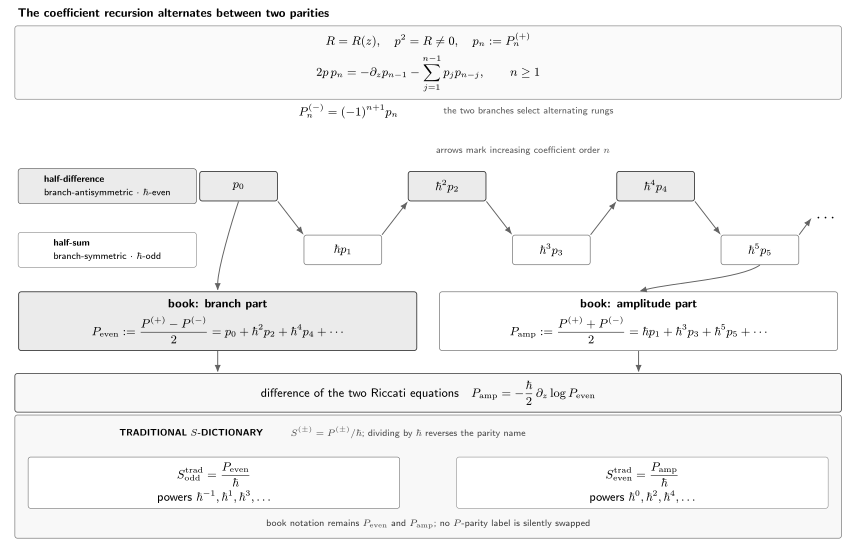
Parity ladder for an -independent normal-form potential. The guide’s is branch-antisymmetric and even in , while is branch-symmetric and odd in . Dividing by produces the traditional exact-WKB -labels.
The source dictionary reverses the parity name
Section titled “The source dictionary reverses the parity name”Let
Here the hats emphasize that the wavefunctions are formal; their explicit normalization is constructed below.
Traditional exact-WKB notation often defines
Consequently,
Both naming schemes are internally consistent. The apparent reversal comes entirely from the factor . This guide retains because its expansion is literally even in and because the formal quantum periods on Page 5 integrate .
The amplitude is fixed by the phase momentum
Section titled “The amplitude is fixed by the phase momentum”Subtract the two Riccati equations:
Using
one obtains
Hence
This identity requires two formal branches of the same Riccati equation, but it does not require to be even in . The parity interpretation does require that extra hypothesis.
Adding the two Riccati equations supplies the complementary relation
Eliminating gives a single equation for the branch-antisymmetric momentum:
This nonlinear equation is another generator for the coefficients of the branch-antisymmetric momentum. Under the parity assumption, those are precisely the even powers. The original triangular recursion is usually simpler for computation, while the reduced equation is better for coordinate-covariance arguments.
Unit normalization fixes the formal Wronskian
Section titled “Unit normalization fixes the formal Wronskian”Because , formal integration gives
The square root exists formally and locally because the leading term is nonzero. The are arbitrary nonzero formal units that do not depend on .
For the displayed unit choice and the guide’s convention
direct differentiation gives
More generally,
This normalization specification matters. If instead both branches are normalized to equal at , their Wronskian is . A quoted constant Wronskian is meaningless until the branch order and both scalar normalizations have been stated.
Another common source normalization uses . It multiplies both columns by and therefore prints the ordered Wronskian as .
The hats are also essential: these are formal solutions. An actual analytic pair with these asymptotics requires a sector, a summation direction, and normalization data from Chapter 9.
A logarithmic derivative is locally exact, not globally disposable
Section titled “A logarithmic derivative is locally exact, not globally disposable”The amplitude one-form satisfies
Locally it integrates to the prefactor . For the -independent potential used in the coefficient formulas above, expanding the logarithm gives
The coefficients from order onward are derivatives of meromorphic functions on the spectral cover. The leading can nevertheless have residues at the divisor of . Even on a closed path, its integral can record a nonzero winding number. On an open path it contributes endpoint normalization.
Thus “the odd-power part is a total derivative” is a local algebraic statement, not permission to erase residues, endpoint terms, or half-density monodromy. Page 5 makes the required subtraction and residue record explicit.
The phase one-form is covariant and the amplitude is a connection
Section titled “The phase one-form is covariant and the amplitude is a connection”Let be an -independent local biholomorphism and write
Thus on the coordinate patch.
Page 1 derived the affine branch transformation
Taking the difference and the sum gives
Therefore
while
The first is the canonical WKB one-form. The second is the connection term that makes the normalized formal wavefunction transform as
The same inverse-half-density factor preserves the ordered Wronskian:
This covariance uses the Schwarzian correction to the transformed normal-form potential. Treating as a scalar would invalidate the branch equations from which these formulas follow.
Turning points predict coefficient growth
Section titled “Turning points predict coefficient growth”For an -independent potential, every produced by the recurrence is holomorphic at an ordinary point where is holomorphic and nonzero. Near a generic simple turning point, write
Set and choose . The recurrence gives, for ,
where
Induction shows : if the earlier coefficients are negative, both terms in the second line are negative. Thus no leading cancellation occurs. In the cover coordinate , has a meromorphic pole of order . The rapidly increasing pole order explains why an outer WKB series is nonuniform near a turning point. It is also compatible with, but does not by itself prove, the factorial large-order growth found under the hypotheses of Chapter 9.
The pole estimate is local bookkeeping, not yet a large-order theorem. Page 3 constructs the normalized cover and classifies zeros and poles; Chapter 9 supplies the Gevrey and Borel statements.
Reproducible coefficient check
Section titled “Reproducible coefficient check”The formal recursion check generates the coefficients through a declared finite order, verifies the Riccati residual on both branches, tests the parity split and logarithmic amplitude identity, and checks the normalized Wronskian. Run
python3 public/code/advanced-ode/wkb-formal-recursion-check.pyThe script uses exact SymPy algebra, prints its interpreter and dependency versions, and raises explicit errors rather than relying on Python assertions.
Common pitfalls
Section titled “Common pitfalls”Calling a Riccati solution. It is a linear combination of two Riccati solutions, and the Riccati equation is nonlinear. It instead satisfies the reduced equation displayed above.
Using parity without checking . The branch relation survives an Schwarzian term but generally fails when . The definitions by branch sum and difference still make sense, but their series no longer contain only one parity.
Forgetting the scaling in a source. The traditional odd part of is . It is not a contradiction that this guide calls the numerator even.
Dropping every amplitude integral. A logarithmic derivative is locally exact. Around zeros and poles it can carry residues and winding, and along an open path it changes endpoint normalization.
Quoting without a normalization. That value belongs to the ordered pair with unit formal constants. Reversing the order or rescaling either column changes it.
Exercises
Section titled “Exercises”1. Derive the triangular recurrence
Section titled “1. Derive the triangular recurrence”Insert into and derive the recurrence for .
Solution
The coefficient of is
where . At order zero, . For , isolate the and terms:
Putting and dividing by gives the displayed formula.
2. Prove the branch-parity relation
Section titled “2. Prove the branch-parity relation”Assume . Show that solves the same Riccati equation and identify its leading term.
Solution
Set
Then
Its leading term is , so formal uniqueness identifies it with . Coefficient comparison yields .
3. Recover the amplitude and Wronskian
Section titled “3. Recover the amplitude and Wronskian”Subtract the two Riccati equations, derive , and compute for unit formal constants.
Transfer check. Replace the unit constants by nonzero constants and . Which combination of them controls the Wronskian, and what happens when the ordered pair of branches is exchanged?
Hint 1: the main idea
Subtract the two Riccati equations for the same potential. The quadratic terms factor into a branch difference times a branch sum, relating phase and amplitude.
Hint 2: an intermediate target
Use and . In the Wronskian, first factor out and subtract their logarithmic derivatives.
Solution
Factoring the difference gives
Division by gives the amplitude identity. For the unit-normalized pair,
Therefore
because .
Transfer answer. Constant rescaling gives . Reciprocal rescalings preserve the unit Wronskian, while independent arbitrary rescalings need not. Exchanging the ordered solutions reverses its sign, yielding .
4. Transform phase and amplitude separately
Section titled “4. Transform phase and amplitude separately”Starting from
derive the transformation laws for and .
Solution
The affine term is the same on both branches, so it cancels in the difference and doubles in the sum:
Multiplication by and use of gives the two one-form laws on this page.
5. See how an odd source breaks parity
Section titled “5. See how an odd source breaks parity”Let
Compute and show that it is no longer branch-symmetric when .
Transfer check. Test the result on the constant potential . Compare it with the exact constant logarithmic derivatives and explain why an even-power-only phase calculation fails.
Hint 1: the main idea
Collect the coefficient of in . The right-hand side now contains a source; the recurrence for an even potential cannot simply be reused unchanged.
Hint 2: an intermediate target
The order-one equation is . Compare the two choices . For constant , the derivative term vanishes and the Riccati equation is algebraic.
Solution
At order ,
With ,
The second term changes sign between branches, so already
The branch difference is no longer an even series. This is precisely the obstruction excluded by .
Transfer answer. For , the two constant solutions are . Their half-difference contains the order- term . An implementation that stores only even powers of the phase would discard a real correction to this equation. The failure comes from an inapplicable parity assumption, not from insufficient truncation order.
References
Section titled “References”- K. Iwaki, “Les Houches Lectures on Exact WKB Analysis and Painlevé Equations”, arXiv:2512.17599v2, May 2026, §1.1.1. Derives the Riccati recurrence, branch decomposition, and normalized formal solutions, from which the constant Wronskian follows in an unscaled logarithmic-derivative convention.
- K. Iwaki and T. Nakanishi, “Exact WKB Analysis and Cluster Algebras”, Journal of Physics A: Mathematical and Theoretical 47 (2014), 474009, §§2.1 and 2.3–2.4, especially equations (2.4)–(2.18) and (2.27). These sections fix widely used odd/even exact-WKB terminology, the associated WKB solutions, and their coordinate behavior.
- T. Kawai and Y. Takei, Algebraic Analysis of Singular Perturbation Theory, Translations of Mathematical Monographs 227, American Mathematical Society, 2005. Gives the systematic formal and exact WKB normalization framework.
- J. L. Dunham, “The Wentzel–Brillouin–Kramers Method of Solving the Wave Equation”, Physical Review 41 (1932), 713–720. Develops the all-orders one-dimensional WKB expansion and the closed-contour quantization series that motivates later quantum-period methods.