
Virasoro Representations and Conformal Blocks
In a two-dimensional CFT, holomorphic—or chiral—symmetry organizes a correlator into contributions from individual conformal families. A Virasoro conformal block is one such contribution after a fusion or sewing channel has been chosen: one highest-weight representation, together with all its descendants, propagates through the internal line. Once the central charge, external and internal weights, local coordinates, and normalization are fixed, every descendant contribution follows from the Virasoro commutators. This makes conformal blocks algorithmic special functions and explains why they can encode linear ODE data.
The crucial qualification is that a generic Virasoro block does not satisfy a second-order ODE. That equation appears when one inserted field belongs to a level-two degenerate representation. Its null state becomes a second-order Belavin–Polyakov–Zamolodchikov (BPZ) differential operator. A four-point block with one degenerate insertion yields the rigid hypergeometric problem. A generic Heun construction instead uses four nondegenerate punctures plus an additional degenerate probe; its exact finite-central-charge equation is a PDE in the probe position and the cross-ratio, and becomes an oper ODE only in a controlled classical limit.
On the ODE side, the required landmarks are regular singularities, normalized connection matrices, the hypergeometric connection benchmark, and four-puncture accessory geometry.
Six objects that the CFT–ODE dictionary must keep distinct
Section titled “Six objects that the CFT–ODE dictionary must keep distinct”The word “block” is often used while silently changing one of its defining data. The following record fixes the distinctions used throughout Chapters 6 and 7.
| Object | Defining data | Role in an ODE problem |
|---|---|---|
| Highest-weight module | , highest weight , and whether null states are quotiented | Supplies the descendant state space |
| Chiral block | Modules, normalized three-point chiral vertices (intertwiners), channel, local coordinates, and normalization | A multivalued holomorphic building block; generically no finite-order ODE |
| Full correlator | A CFT spectrum, structure constants, antiholomorphic blocks, and a sum or contour | A model-dependent, suitably single-valued observable |
| Degenerate-insertion block | A block containing a module with a null relation | Level-two decoupling gives two local fusion branches; with four total insertions it closes to an ODE, while additional moduli generally leave a PDE |
| Classical block | A heavy limit with a fixed exponentiation convention | Generates an oper accessory residue |
| Analytic block family | Complex weights, channel, normalization, and an internal-momentum shift lattice | A Fourier-weighted sum of the family builds selected isomonodromic tau functions in Chapter 7 |
The last two rows belong to different regimes. With the guide convention
the value has and , whereas gives . Neither limit may be substituted for the other.
Virasoro symmetry becomes descendant linear algebra
Section titled “Virasoro symmetry becomes descendant linear algebra”The holomorphic stress tensor has a Laurent expansion around the origin,
Its modes obey the Virasoro algebra
In this representation-theory section, bare denotes an abstract Virasoro highest weight. Once CFT weights are placed beside ODE coefficients, the superscript will make the distinction explicit.
The modes , , and form the global subalgebra: the central term vanishes for these indices. The remaining modes encode local conformal transformations that have no analogue in a higher-dimensional global conformal group.
A highest-weight state satisfies
Acting with lowering modes produces descendants
The algebraic anti-involution reverses products. For the dual ordering used below, write
The reversal is essential: is not the same ordered product with all signs changed.
The partition has level . Commuting through the lowering modes gives
The freely generated module is the Verma module . Its Poincaré–Birkhoff–Witt basis has level- dimension equal to the partition number for every , so its formal character is
Here is a character variable, not a Heun accessory, Painlevé coordinate, or elliptic nome. At a degenerate weight, the irreducible quotient has a smaller character.
Gram matrices detect null states
Section titled “Gram matrices detect null states”The contravariant or Shapovalov form is fixed by the anti-involution and the normalization
At each level,
At level one the only state is and
At level two, in the ordered basis
the matrix is
A vanishing Gram determinant means that the Verma module is reducible. A kernel vector lies in the radical of the form and is null. A primitive kernel vector at its first occurrence is singular—positive Virasoro modes annihilate it—and its descendants generate a null submodule. The degenerate irreducible module is obtained by quotienting by the radical. Merely substituting a degenerate weight into a generic inverse-Gram formula produces a pole; it does not perform the quotient.
This distinction will matter twice:
- on the next page, setting a level-two null state to zero produces the BPZ equation;
- in Chapter 7, poles of a block as a meromorphic function of its internal weight are kept distinct from Frobenius resonance of an ODE.
Primary fields turn the algebra into Ward identities
Section titled “Primary fields turn the algebra into Ward identities”A chiral primary field is characterized by
Equivalently,
Under radial state–operator correspondence,
up to normalization. Thus the descendant basis constructed above becomes the set of descendant insertions used in sewing.
For a chiral correlator or conformal block, contour deformation gives the Ward identity
The three global modes fix the coordinate dependence of two- and three-point functions up to constants. For example,
in a discrete diagonal notation. The coefficient is a choice of two-point normalization; it is not fixed by the Virasoro algebra.
For four insertions, global symmetry leaves one complex cross-ratio. This chapter uses the ordered positions
and defines
The cross-ratio is the same four-puncture coordinate used in the Heun and isomonodromy chapters. Its branch and continuation path remain part of the block data.
Global Ward identities reduce the position dependence; they do not produce a second-order equation. That requires an additional null-vector identity.
Sewing a channel defines the chiral block
Section titled “Sewing a channel defines the chiral block”At a puncture or sewing node, a local coordinate is an analytic parameter that vanishes there. Rescaling that parameter rescales states and three-point vertices, so it belongs to the normalization specification even when the standard sphere coordinates make it invisible.
Fuse with and choose an intermediate highest weight . At level , the projector onto the corresponding descendant space is
Inserting between the two pairs of fields defines the -channel block. Normalize the primary three-point vertices out of the answer. The result has the form
The hatted block starts with one; the unhatted block includes the OPE power. This convention will be essential when a logarithmic derivative is identified with an accessory parameter.
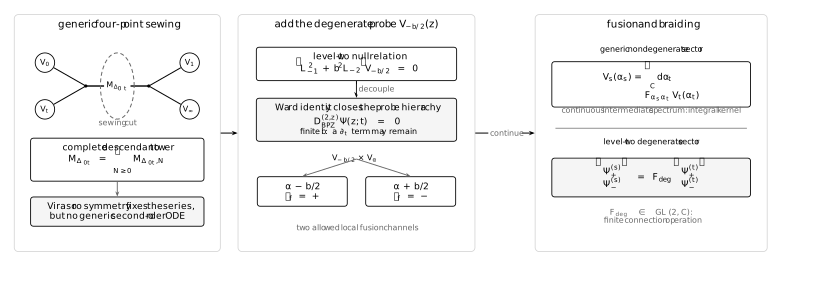
Generic sewing propagates the complete intermediate Verma module and does not imply a second-order equation. Adding the light degenerate field supplies a level-two null relation and two fusion branches. Only this degenerate sector reduces fusion and braiding to finite connection operations.
The first coefficient is an exact normalization check
Section titled “The first coefficient is an exact normalization check”At level one, the inverse Gram matrix contributes . The two normalized descendant three-point matrix elements are
Therefore
This coefficient is independent of because level one uses only the global generator . Central-charge dependence enters at level two through .
Replacing the Virasoro sewing projector by the projector onto the global descendant tower introduces the short parameters
The global block then resums to
This is a useful software benchmark, not the generic Virasoro block. The latter also includes descendants. In selected large-central-charge scalings the global block can be the leading approximation, but it is not obtained merely by declaring “large.”
Formal series versus analytic block
Section titled “Formal series versus analytic block”The sewing formula always defines a formal power series away from Gram determinant zeros. In a CFT or vertex-algebra setting satisfying the appropriate analytic sewing hypotheses, that series represents a holomorphic block in a plumbing domain. This page does not assert a universal radius-of-convergence theorem for arbitrary complex and weights. Numerical use must state which series or recursion is being evaluated and test its truncation.
A block is not a full correlator
Section titled “A block is not a full correlator”The full four-point function schematically decomposes as
The superscript “anti” labels the antiholomorphic sector; it does not assume that analytically continued chiral data are related by literal complex conjugation.
For a discrete spectrum, the integral is replaced by a sum. The spectrum , measure, structure constants, pairing of chiral and antichiral representations, and integration contour are dynamical data of the CFT. None is fixed by the holomorphic Virasoro algebra alone.
Consequently:
- a chiral block is generally multivalued and channel dependent;
- a full physical correlator is assembled to have the required locality and single-valuedness;
- analytic continuation of one block gives a linear combination or integral transform of blocks in another channel;
- crossing symmetry constrains the full correlator, including its structure constants.
In the generic nonrational Virasoro setting used here, fusion is an integral transform over intermediate momentum. The finite connection matrices relevant to a second-order ODE arise after a level-two degenerate fusion rule restricts the intermediate weights to two possibilities.
Liouville momenta parameterize Virasoro weights
Section titled “Liouville momenta parameterize Virasoro weights”The guide parameterizes the central charge and conformal weights by
The centered momentum
gives
The reflection sends and leaves the weight unchanged. At the level of a Virasoro module, these are two momentum labels for the same . A physical Liouville field can carry a nontrivial reflection coefficient, which belongs to the correlator normalization rather than to the abstract module.
This parameterization is algebraic and allows complex . Real positive describes the usual spacelike Liouville range , but this chapter does not assume unitarity or that every inserted representation belongs to a physical Liouville spectrum.
The guide’s level-two branch
Section titled “The guide’s level-two branch”The degenerate field used for the ODE limit is
with weight
and null relation
Its generic fusion shifts are
The dual field has null relation with . Under the guide’s convention it is heavy, not interchangeable with ; it becomes the light presentation after the dual exchange . The null relation and fusion shifts—not the Kac label alone—fix the convention.
The second-order equation has a precise insertion pattern
Section titled “The second-order equation has a precise insertion pattern”The following firewall prevents three common configurations from being called “the four-point block.”
| Insertions | Exact equation | ODE meaning |
|---|---|---|
| Four nondegenerate primaries at | Virasoro Ward identities and a block series | No generic second-order BPZ equation |
| Three nondegenerate primaries plus | Second-order BPZ equation in the only cross-ratio | Three regular singularities; hypergeometric benchmark |
| Four nondegenerate primaries plus | BPZ PDE in the probe coordinate and modulus | In the heavy–light limit, a four-pole oper and Heun-type ODE |
At finite , the last row contains a modulus derivative ; “holding fixed” does not erase that term. With heavy external and internal weights
and a compatible channel normalization, the factorization
turns the PDE into
The classical block principally determines an accessory residue through a declared derivative such as . If the normalized block is used instead, the leading OPE power adds an explicit term. A scalar gauge and local solution normalizations are still required before a CFT fusion coefficient becomes the guide’s ODE connection matrix.
Chapter 5 reached a charged-partition series for tau directly from Fredholm principal minors. Chapter 7 will give that series an independent block interpretation. The classical factorization above serves a different purpose: it builds an oper and its accessory parameter.
The chapter follows the null state from algebra to connection data
Section titled “The chapter follows the null state from algebra to connection data”| Page | Main construction | Safeguard |
|---|---|---|
| Virasoro representations and blocks | Descendant sewing | Block correlator |
| Degenerate fields and null-vector decoupling | Level-two quotient | Degenerate module singular Verma formula |
| BPZ equations as second-order ODEs | Position fixing and canonical reduction | Hypergeometric four insertions Heun five insertions |
| Degenerate fusion and braiding | Two fusion branches | Generic fusion remains an integral transform |
| Heavy–light classical limit | Controlled factorization | Exact PDE limiting ODE |
| Classical blocks, opers, and accessories | Accessory derivative | Accessory data normalized connection coefficient |
| Irregular states and confluent BPZ equations | Scaled collision | Naive collision irregular limit |
| Normalization and worked example | Hypergeometric connection matrix | Fusion matrix requires basis and gauge conversion |
This is deliberately not a general CFT course. It develops exactly the representation theory, block sewing, null vectors, fusion operations, and irregular limits needed by the ODE applications.
Common pitfalls
Section titled “Common pitfalls”Calling a chiral block a correlator. A block is fixed by representation and sewing data. A correlator additionally needs a spectrum, structure constants, an antiholomorphic sector, and a locality prescription.
Expecting every block to satisfy a second-order ODE. Virasoro symmetry gives Ward identities and an infinite descendant expansion. A second-order BPZ operator requires a level-two degenerate insertion.
Replacing generic fusion by a matrix. Nondegenerate Virasoro fusion is generically an integral kernel. The finite matrix belongs to the two-channel degenerate sector.
Dropping the OPE prefactor. The hatted block starts with one, while the unhatted block contains . Their logarithmic derivatives differ by an explicit simple pole.
Mixing with . The first is an analytic finite-central-charge regime; the second is a large-central-charge semiclassical limit. They encode different ODE data.
Exercises
Section titled “Exercises”1. Recover the global subalgebra
Section titled “1. Recover the global subalgebra”Use the Virasoro commutator to show that , , and form and receive no central term.
Solution
The relevant commutators are
For , the factor vanishes, so there is no central term. With , , and , these become the standard relations.
2. Compute the level of a descendant
Section titled “2. Compute the level of a descendant”Prove
Solution
The Virasoro relation gives
Commute successively through . Each lowering mode contributes and the final contributes . Their sum is .
3. Derive the level-two Gram matrix
Section titled “3. Derive the level-two Gram matrix”Starting from the Virasoro algebra, compute the Gram matrix in the basis , .
Solution
First,
Next,
using . Finally, repeated use of gives
These entries reproduce the matrix in the text.
4. Verify the guide’s null direction
Section titled “4. Verify the guide’s null direction”Set
Show that the level-two Gram matrix annihilates the vector associated with .
Solution
In the ordered basis , the vector is . Substitution gives
The first row applied to vanishes. Also , so the second row gives
Thus this descendant lies in the radical of the Verma-module Gram form and is set to zero in the irreducible degenerate quotient.
5. Reproduce the first block coefficient
Section titled “5. Reproduce the first block coefficient”Use the level-one projector to derive . Which part of the answer depends on the central charge?
Solution
The normalized right and left three-point matrix elements are
Multiplying them by the inverse Gram entry gives the coefficient displayed in the text. Nothing at level one depends on ; the first central term enters at level two.
6. Separate the two Liouville regimes
Section titled “6. Separate the two Liouville regimes”Find when , and determine the leading behavior of as . Why are these not the same limit?
Solution
requires , so
and hence . By contrast,
so sends to infinity. The former is a finite-central-charge analytic continuation; the latter is a classical heavy-weight scaling.
7. Diagnose three ODE claims
Section titled “7. Diagnose three ODE claims”Classify the following statements.
- A generic nondegenerate four-point Virasoro block satisfies a second-order ODE.
- A four-point block containing one level-two degenerate field gives a hypergeometric-type BPZ equation.
- Four nondegenerate insertions plus a degenerate probe give an exact finite- Heun ODE after one simply fixes .
Solution
Statement 1 is false: no null relation closes the Ward identities at second order. Statement 2 is true on the generic nonresonant chart after the coordinate prefactor is fixed; there are only three singular points. Statement 3 is false: the exact five-point BPZ equation contains a -derivative and is a PDE. The Heun-type oper ODE follows after the controlled heavy–light factorization.
References
Section titled “References”- A. A. Belavin, A. M. Polyakov, and A. B. Zamolodchikov, “Infinite Conformal Symmetry in Two-Dimensional Quantum Field Theory”, Nuclear Physics B 241 (1984), 333–380. Virasoro conformal families, degenerate representations, conformal blocks, and BPZ equations.
- P. Di Francesco, P. Mathieu, and D. Sénéchal, Conformal Field Theory, Springer, 1997. Standard account of two-dimensional conformal symmetry, highest-weight representations, null vectors, and block decompositions.
- S. Ribault, Conformal Field Theory on the Plane, 2014. A freely available treatment of Virasoro representations, BPZ equations, conformal blocks, Liouville theory, and analytic continuation.
- J. Teschner, “Liouville Theory Revisited”, Classical and Quantum Gravity 18 (2001), R153–R222. Liouville spectrum, chiral operators, reflection, braiding, and bootstrap normalization.
- B. Ponsot and J. Teschner, “Liouville Bootstrap via Harmonic Analysis on a Noncompact Quantum Group”, arXiv:hep-th/9911110 (1999). Announces the generic continuous fusion transformations and their analytic structure under the assumptions stated in the paper.
- Al. B. Zamolodchikov, “Conformal Symmetry in Two Dimensions: An Explicit Recurrence Formula for the Conformal Partial Wave Amplitude”, Communications in Mathematical Physics 96 (1984), 419–422. Recursive computation of generic Virasoro four-point blocks.
- G. Bonelli, C. Iossa, D. Panea Lichtig, and A. Tanzini, “Irregular Liouville Correlators and Connection Formulae for Heun Functions”, Communications in Mathematical Physics 397 (2023), 635–727. Degenerate four- and five-point blocks, heavy limits, irregular states, and Heun connection formulae.
- A. Litvinov, S. Lukyanov, N. Nekrasov, and A. Zamolodchikov, “Classical Conformal Blocks and Painlevé VI”, Journal of High Energy Physics 2014 (7), 144. Classical exponentiation, monodromy, and accessory parameters.