
The Heun Confluence Hierarchy
The Heun hierarchy is not a list of increasingly complicated function names. It is the classification obtained when the four regular singularities of the general Heun equation merge in controlled groups. A two-point cluster generically creates a rank- irregular point, a three-point cluster a rank- point, and a four-point cluster a rank- point.
The word controlled is essential. Singular locations must move while parameters, coordinates, and sometimes gauges scale so that a higher polar moment survives. Merely setting two locations equal usually produces a degenerate equation, not the intended confluent class. This page turns that principle into a five-row atlas and verifies one complete limit.
Five collision partitions, not one ladder
Section titled “Five collision partitions, not one ladder”Ignore the labels of the four original regular singularities and record only which ones have joined the same collision cluster. The five integer partitions of are
They give precisely the five standard Heun types:
| Partition | Generic pattern | Class / label |
|---|---|---|
| GHE / HeunG | ||
| CHE / HeunC | ||
| DCHE / HeunD | ||
| BHE / HeunB | ||
| THE / HeunT |
Here denotes a regular singularity and a generic unramified irregular singularity of rank . This is the standard generic Heun confluence scheme: special coefficient cancellations can make a nominal regular point ordinary or lower an irregular slope.
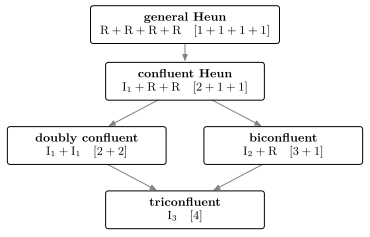
The Heun confluence diamond. Each arrow merges one more collision block, but it represents a scaled limit of coefficients—not a collision of positions alone. The diagram classifies singularity patterns; it does not specify a unique parameter map or solution normalization.
The two middle partitions are incomparable: and are alternative coarsenings of . Thus the doubly confluent and biconfluent equations are sibling branches, not successive rungs of one chain.
One DLMF convention fixes all five equations
Section titled “One DLMF convention fixes all five equations”Names such as “HeunC” do not by themselves specify an ODE. On this page all canonical equations use the DLMF forms. The same letters are reused by that source, so the parameters in one displayed equation are local to that equation; they do not pass unchanged through an arrow of the diagram.
General Heun: four regular points
Section titled “General Heun: four regular points”The starting equation is
with
The candidate singularities , , , and are all regular, and generically none is removable. After Möbius normalization the equation has six independent canonical parameters: .
Confluent Heun: two regular points and rank one
Section titled “Confluent Heun: two regular points and rank one”The DLMF confluent Heun equation is
The points and are generically regular singularities, while infinity is generically irregular of rank . This canonical form has five parameters.
Doubly confluent Heun: rank one at both ends
Section titled “Doubly confluent Heun: rank one at both ends”The DLMF doubly confluent equation is
The only singularities are and ; generically both are irregular of rank . Generically there is no regular singular point at which to define a Frobenius-normalized local function. The canonical equation has four parameters.
Biconfluent Heun: one regular point and rank two
Section titled “Biconfluent Heun: one regular point and rank two”The DLMF biconfluent equation is
The minus sign is part of this convention. The point is generically regular and infinity is generically irregular of rank . This equation also has four parameters, but its singularity partition differs from the doubly confluent case.
Triconfluent Heun: one rank-three point
Section titled “Triconfluent Heun: one rank-three point”The DLMF triconfluent equation is
Every finite point is ordinary. The only singularity lies at infinity and is irregular of rank . Three parameters remain after the canonical coordinate and gauge normalizations.
| Class | Canonical parameter count | Finite regular points | Irregular points |
|---|---|---|---|
| GHE | none | ||
| CHE | of rank | ||
| DCHE | none | of rank | |
| BHE | of rank | ||
| THE | none; all finite points are ordinary | of rank |
The counts describe these canonical forms, not the dimension of every physical parameter space that can reduce to them.
Normal form reads off the generic rank
Section titled “Normal form reads off the generic rank”For
the Liouville substitution
gives
Near a finite point , a generic unramified centered/projective rank- irregular type has
More generally, if with , its centered, or projective, formal slope is . Even gives the integer, unramified slopes displayed here; odd signals a ramified half-integer slope. For the five DLMF canonical equations on this page, this centered check agrees with their stated generic ranks.
At infinity, inversion is Möbius and has zero Schwarzian. After the accompanying half-density rescaling that restores Liouville normal form, the transformed coefficient is
Equivalently, centered/projective rank at infinity corresponds generically to
Applying this test gives a useful check:
| Type, point, rank | Leading | Centered pair |
|---|---|---|
| GHE, , | powers of | |
| CHE, , | ||
| DCHE, , | ||
| DCHE, , | ||
| BHE, , | ||
| THE, , |
The signs in the exponential pairs can be exchanged. The table reads the exponential difference. A common nonmeromorphic exponential twist can change the full Katz rank while leaving this centered data unchanged; a meromorphic scalar gauge cannot. Thus an arbitrary uncentered presentation still requires the full formal check of Chapter 1.
A complete general-to-confluent limit
Section titled “A complete general-to-confluent limit”The first arrow can be verified without guesswork. Fix target CHE parameters
and let the third finite Heun singularity be . In the general Heun equation choose
The Fuchs relation holds exactly:
For fixed away from and ,
Moreover,
so
Thus the general Heun coefficients converge locally uniformly on compact subsets of
to the CHE coefficients. With fixed, -independent initial data at an ordinary base point, the solutions converge uniformly on compact subsets of any fixed simply connected domain avoiding and once lies outside it. Equivalently, one may state convergence along fixed continuation paths. This is standard continuous dependence on ODE coefficients.
What made the limit confluent was not only . The parameters , , and scale linearly with so that an irregular polar moment survives; diverges when and remains zero when . If every general-Heun parameter were held fixed, the disappearing pole would contribute neither the constant in nor the linear numerator in the target equation.
The two middle branches encode different collisions
Section titled “The two middle branches encode different collisions”The diamond can now be read geometrically.
Confluent to doubly confluent
Section titled “Confluent to doubly confluent”The CHE has one double cluster and two singleton clusters:
Merging the two singleton clusters with a compensating parameter scaling creates a second rank- irregular point:
The result has two irregular ends. Problems in this class naturally require sectorial data at both ends rather than a regular-to-irregular connection.
Confluent to biconfluent
Section titled “Confluent to biconfluent”Instead, merge one singleton into the existing double cluster:
The original irregular point rises from rank to rank , while one regular singularity remains. This is the biconfluent pattern, not the doubly confluent one.
Finally, merging the two blocks of either or gives the single four-point cluster , hence the triconfluent rank- type. These are statements about collision partitions. Each concrete arrow still needs its own coordinate, parameter, and gauge scaling.
Equation class and named function are different data
Section titled “Equation class and named function are different data”The abbreviations GHE, CHE, DCHE, BHE, and THE classify equations. The software-style labels HeunG, HeunC, HeunD, HeunB, and HeunT select particular solutions only after a parameter convention and normalization have been declared.
| Class | Geometry near in the DLMF chart | Natural local datum |
|---|---|---|
| GHE | Regular singular | A Frobenius branch, often analytic and normalized to |
| CHE | Regular singular | A Frobenius branch, often analytic and normalized to |
| DCHE | Irregular singular | Sectorial asymptotics; a CAS may instead normalize at an ordinary point |
| BHE | Regular singular | A Frobenius branch after fixing the equation convention |
| THE | Ordinary point | Two initial values determine an entire solution |
This distinction is most acute for HeunD: in the two-irregular-point canonical picture, is not a place where “analytic and equal to ” defines a Frobenius solution. Different packages use different canonical charts and ordinary-point normalizations. The later parameter-crosswalk page will translate the house, DLMF, Maple, and Wolfram forms; until then, always write the ODE beside the function symbol.
What confluence preserves—and what it replaces
Section titled “What confluence preserves—and what it replaces”A controlled outer limit preserves the differential order and, after a fixed initial-value normalization, the two-dimensional solution space on common domains away from the collision. It does not preserve every familiar piece of Fuchsian data in its original form.
| Before collision | After an irregular confluence |
|---|---|
| Frobenius powers at separate regular points | Formal exponentials, formal powers, and sectorial sums |
| Individual small loops | A loop around the cluster and sector-dependent Stokes factors |
| Local exponent differences | Irregular type plus formal monodromy data |
| Raw connection matrices between Frobenius bases | Renormalized limits that can produce Stokes matrices |
| A finite accessory coordinate | A scaled or shifted target accessory coordinate |
The product of monodromies around a shrinking cluster can approach the full analytic monodromy of the irregular point, which factors into formal monodromy and Stokes matrices. A single raw local monodromy matrix does not generically become a single Stokes matrix. Chapter 1’s confluence analysis gives the required outer, inner, and basis-normalization specification; the next page constructs the canonical local and asymptotic bases for the five Heun classes.
Common pitfalls
Section titled “Common pitfalls”Drawing a linear hierarchy. The doubly confluent and biconfluent equations are different branches from the CHE. Their parameter counts happen to agree, but their singularity patterns do not.
Colliding positions without scaling coefficients. Bounded residues usually yield a regular or degenerate limit. An irregular type requires a higher polar moment to survive.
Treating the generic rank as universal. Vanishing leading coefficients can lower or ramify the formal type. Recompute or the invariant formal slopes on special parameter strata.
Carrying the same parameter names through an arrow. DLMF reuses across inequivalent equations. A confluence map generally shifts, rescales, or sends several of them to infinity.
Equating coefficient convergence with function convergence. Fixed initial-value solutions behave continuously on a common outer domain, but Frobenius or sectorial bases can diverge and require right renormalizations.
Calling a CAS symbol a canonical equation. A function name also hides a normalization, branch, and sometimes a different chart. State the ODE and initial or asymptotic data.
Exercises
Section titled “Exercises”1. Recover the five classes from partitions
Section titled “1. Recover the five classes from partitions”List the integer partitions of . Within the standard generic Heun confluence scheme, replace every block of size by an irregular point of rank , with a size- block interpreted as a regular point. Match the five results to the Heun classes.
Solution
The partitions and patterns are
These are all possibilities because the integer partitions exhaust the unlabeled ways to group four objects.
2. Check rank one at the confluent ends
Section titled “2. Check rank one at the confluent ends”For the DLMF CHE, compute through order at infinity. For the DCHE, compute its leading normal coefficient at both and . Recover all three rank- entries in the check table.
Solution
For the CHE,
Therefore
For , the nonzero constant leading term gives rank at infinity and centered formal exponentials .
For the DCHE near ,
Hence
which gives rank and factors when . At infinity,
so the second end also has rank , with factors .
3. Check ranks two and three
Section titled “3. Check ranks two and three”Put the DLMF BHE and THE in normal form. Recover rank for the biconfluent equation and rank for the triconfluent equation.
Solution
For the BHE,
Because ,
The relation gives rank , with centered exponentials .
For the THE,
Again the dominant contribution is , so
Because , the rank is . Equivalently,
whose pole order is . Integrating the leading square root gives the centered exponentials .
4. Verify the general-to-confluent scaling
Section titled “4. Verify the general-to-confluent scaling”Using the parameter scaling in the worked limit, verify the Fuchs relation and both coefficient limits with remainders.
Solution
The definitions first give
Since , the Fuchs relation follows:
For the first-derivative coefficient,
If
then and
on compact sets away from and .
5. Show why a moving point is insufficient
Section titled “5. Show why a moving point is insufficient”Let in the GHE while all coefficients remain bounded. Determine the coefficientwise limit for fixed .
Solution
For fixed ,
and
The limit is therefore
It is a degenerate Fuchsian equation, not the generic CHE. The constant term in the CHE first-derivative coefficient and the nonzero target numerator require the divergent scaling used on the page.
6. Locate the hypergeometric boundary of the CHE
Section titled “6. Locate the hypergeometric boundary of the CHE”Set and in the DLMF CHE. Show that infinity becomes regular and identify Gauss parameters .
Solution
The equation becomes
Now and , so infinity is regular. Comparing with the Gauss equation gives
and
Only setting is not sufficient in general: if , then and infinity remains irregular, though the leading formal type is degenerate from the generic unramified CHE row.
7. Choose the correct starting basis
Section titled “7. Choose the correct starting basis”For generic canonical parameters in each of GHE, CHE, DCHE, BHE, and THE, decide whether naturally supports a Frobenius basis, a sectorial asymptotic basis, or an ordinary initial-value basis in the DLMF chart.
Solution
- Generically, GHE, CHE, and BHE have a regular singularity at , so Frobenius bases are natural, with the usual resonant caveats.
- For , DCHE has an irregular singularity at , so its canonical local objects are formal and sectorial asymptotic bases. A software function may use an ordinary point elsewhere for normalization.
- THE has no finite singularity. The point is ordinary, and two initial values determine an entire solution.
This classification concerns the equation. A symbol such as HeunD or HeunT still requires a package-specific parameter and normalization declaration. On loci such as for DCHE, or after removable-pole cancellations in the other families, the local type must be recomputed.
References
Section titled “References”- NIST DLMF equation 31.2.1 gives the general Heun equation; §31.2(i) gives its exponent and six-parameter convention. The four confluent forms and their singularity ranks are 31.12.1, 31.12.2, 31.12.3, and 31.12.4. Equation 31.12.3 is the corrected BHE form.
- A. Ronveaux, ed., Heun’s Differential Equations, Oxford University Press (1995), book record and DOI: CHE pp. 89–97, DCHE pp. 131–143, BHE pp. 193–198, THE pp. 253–257, and the classification and confluence addenda pp. 305–317.
- S. Yu. Slavyanov and W. Lay, Special Functions: A Unified Theory Based on Singularities, Oxford University Press (2000), Chapter 3, pp. 97–162, organizes the Heun class by singularity structure.
- A. Decarreau, M.-Cl. Dumont-Lepage, P. Maroni, A. Robert, and A. Ronveaux, “Formes canoniques des équations confluentes de l’équation de Heun,” Ann. Soc. Sci. Bruxelles Sér. I 92 (1–2) (1978), 53–78; A. Decarreau, P. Maroni, and A. Robert, “Sur les équations confluentes de l’équation de Heun,” 92 (3) (1978), 151–189. DLMF §31.12 cites these papers for the classification.
- K. Heun, “Zur Theorie der Riemann’schen Functionen zweiter Ordnung mit vier Verzweigungspunkten,” Math. Ann. 33 (1888), 161–179, doi:10.1007/BF01443849.