
Conditional Identification of WKB and Quantum Seiberg–Witten Periods
The principal symbol test on Page 5 established that one particular holomorphic differential operator quantizes the Page 2 pure- curve. It did not establish that a contour integral of its WKB momentum equals a derivative of the Nekrasov–Shatashvili twisted superpotential. That stronger statement compares objects built by different constructions, and every normalization between them must be supplied rather than inferred.
This page makes the comparison in two stages. First it formulates a period dictionary whose hypotheses include the operator, mass and energy maps, polarization, half-form convention, oriented cycles, factor, quantum mirror map, regulator scheme, and analytic chamber. Then it checks the dictionary for pure . The first quantum WKB correction is reduced to a differential operator on the classical periods, the weak A-period is inverted, and the B-period is compared coefficientwise with Page 4. The result is strong evidence in one calibrated model—not a chamber-independent theorem for every quantum curve and not an exact spectral condition.
Four different objects are often called a quantum period
Section titled “Four different objects are often called a quantum period”Before writing an equality, separate the four constructions that it might compare.
| Layer | Object | Definition | What is still missing? |
|---|---|---|---|
| Classical geometry | Quantum operator and deformation | ||
| Formal WKB | coefficientwise | Borel direction and chamber | |
| Gauge NS | Operator/cycle map, scheme, and mirror map | ||
| Sectorial analytic | or a summed Voros symbol | Directional or lateral Borel summation under stated hypotheses | Continuation path and Stokes data |
The first row is an ordinary period of a distinguished meromorphic one-form on a classical family. The second is a formal series whose coefficients are regularized meromorphic period integrals. The third is a derivative of a connected gauge-theory free energy in a chosen Barnes scheme and logarithm chamber. The fourth exists only after analytic summability and continuation questions have been answered.
Even the WKB terminology has two common parity conventions. In this guide, is even in and odd under exchange of the two spectral sheets. Traditional exact-WKB notation calls the odd Riccati part because it is the branch difference. Some quantum-mechanics papers instead call the even momentum. The conversion is
Thus the guide’s additive period, the traditional Voros exponent, and the formal cycle Voros symbol are respectively
Calling all three “the quantum period” loses both a power of and the distinction between additive and multiplicative data.
Period conventions and assumptions are part of the claim
Section titled “Period conventions and assumptions are part of the claim”Suppose a gauge-theory construction and a scalar ODE are proposed to describe the same quantum geometry. The comparison is meaningful only after the following gates have been passed.
- Classical curve and one-form. The ODE principal symbol must be identified with the same spectral curve, and its Darboux form must be related explicitly to . A birational curve map without the one-form map is insufficient.
- Operator package. Polarization, ordering, subprincipal terms, wavefunction bundle, and defect normalization must be fixed. Two operators with the same principal symbol need not have the same quantum periods.
- Deformation parameter. The commutator parameter must be mapped to , including its sign and phase. The phase also rotates the Borel ray.
- Quantum parameters. Bare and centered masses, operator energy, Coulomb modulus, and any finite shifts must remain distinct until a model-specific relation identifies them.
- Period-carrying form. The branch-difference form, amplitude connection, exact-form reductions, residues, and endpoint regularizations must use one declared convention.
- Cycle lattice. Oriented WKB cycles must be matched with an integral electric–magnetic basis and transported by the same Gauss–Manin path. Labels such as and are not portable by themselves.
- Numerical normalization. Every factor multiplying , especially , must be retained. Source conventions for , , and must be translated as a package.
- Quantum mirror map. The operator modulus must be expressed in the flat quantum A-period coordinate on a patch where that map is locally invertible.
- Gauge scheme and branch. The perturbative subtraction, logarithm sheet, decoupled Abelian factors, and any boundary superpotential must be specified. A quadratic counterterm shifts the dual derivative.
- Analytic realization. If the claim is about functions rather than formal series, it must specify the Borel direction, lateral side, Stokes chamber, and continuation path. An domain or other boundary condition is additional spectral data.
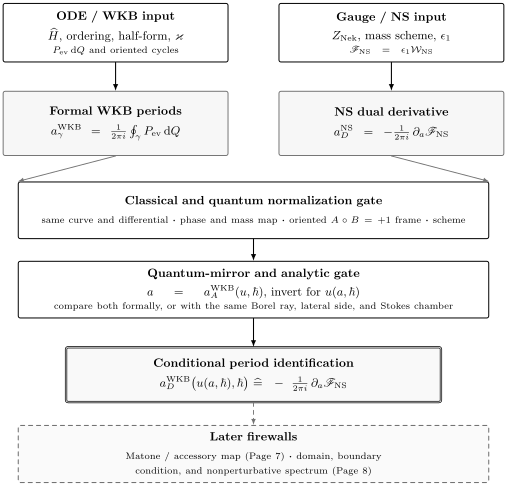
The period dictionary is a gated comparison. The ODE lane constructs a branch-difference WKB form and oriented cycle integrals; the gauge lane constructs the NS free energy and its dual derivative. Their classical normalization, quantum mirror map, scheme, and—when analytic functions are compared—Borel chamber must agree. Neither the conditional equality nor its exponential supplies the Page 7 accessory map or the Page 8 spectral domain.
A compact conditional statement
Section titled “A compact conditional statement”Let be a simply connected patch away from the discriminant. Choose Gauss–Manin-transported cycles with , an operator specification, and a regularized branch-difference form
Define the normalized formal WKB coordinates
Select the A-branch with the required classical asymptotic and assume . The formal quantum mirror map is the local inverse
After the gauge scheme and logarithm branch have been calibrated, the candidate quantum special-geometry statement is
Here means conditional identification in the declared specification. It is not a new equality symbol to be manipulated outside those hypotheses. Equivalently, before dividing by ,
At the purely formal level this is an equality to be tested coefficientwise in and, at weak coupling, in . At the analytic level both sides must be assigned compatible resummations. The latter claim can be weaker, stronger, or simply different in different chambers.
The exponentiated form is
This removes additive logarithm-sheet shifts compatible with the chosen lattice. It still does not impose that either side equal one. That extra equation is a Bethe-vacuum condition only when is a dynamical two-dimensional Coulomb variable with the appropriate boundary contribution.
The pure-SU(2) classical factor fixes both periods
Section titled “The pure-SU(2) classical factor fixes both periods”Use the Page 5 logarithmic chart and Page 2 normalization:
On the weak-coupling sheet , orient by . Choose so that and so that it collapses at the Page 2 monopole point . Then, at ,
The factor is forced by the differential. It is not a WKB choice, and it cannot be replaced by a source’s normalization without simultaneously translating that source’s , , cycles, and phase convention.
The weak electric period is
and both classical periods satisfy
The same differential equation does not erase the cycle labels. Its two solutions acquire meaning only after their weak asymptotics, orientation, intersection pairing, and continuation paths have been fixed.
The branch difference carries the quantum period
Section titled “The branch difference carries the quantum period”For the holomorphic operator
it is useful to retain the canonical parameter . Define the two formal Riccati branches by
Because is even in ,
Split their branch difference and branch average as
The first is even in and begins with ; the second is odd in . Subtracting the two Riccati equations gives the exact formal identity
Therefore
Locally the second term is exact and supplies the WKB amplitude. Globally its integral can remember the divisor of . If
then a full-branch integral obeys
On the nonresonant weak A-cylinder one can choose the transported contour with . Around turning-point divisors or after a global continuation, silently dropping the amplitude term can lose the half-form or Maslov contribution. This is why the quantum Seiberg–Witten candidate is defined using , while wavefunction monodromy is reconstructed with the amplitude normalization retained.
The same split makes coordinate covariance explicit. Let and
For a wavefunction, the two full Riccati branches transform with a connection term:
The connection cancels in the branch difference, so
Thus the period-carrying object is a formal one-form once the half-form convention is fixed. A full branch is a connection-valued momentum, which is precisely why its logarithmic contribution must not be erased globally.
Eliminating also gives a nonlinear equation for the period-carrying momentum alone:
This expression makes two points transparent: the quantum period has only even powers of , and changing the scalar normal form or half-density convention can change the subprincipal data from which those coefficients are computed.
The first quantum correction is a Picard–Fuchs operator
Section titled “The first quantum correction is a Picard–Fuchs operator”Write
Direct Riccati recursion gives
The local expression has poles at the turning points . It must be integrated using the compatible-cycle and regularization convention of Chapter 8. For a closed transported cycle away from the discriminant, an exact-form reduction turns the answer into a differential operator on the classical period.
Set
Since , one finds
On the other hand, differentiating at fixed gives
Therefore, modulo the displayed exact derivative,
All derivatives here are Gauss–Manin derivatives: the homology class is transported horizontally while the form changes. Integrating around either Page 2 cycle yields
The operator is the same for and because the reduction took place at the level of the one-form before choosing a solution of the Picard–Fuchs equation. It is not a claim that the periods themselves are the same.
A second reduction checks the coefficient
Section titled “A second reduction checks the coefficient”Let
and write
Differentiation under the transported integral and reduction of powers of give
The Page 2 Picard–Fuchs equation and its derivative reduce the right-hand side to
confirming the coefficient . A source using can print after its derivatives are translated. The discrepancy is then a modulus normalization, not a different WKB recursion.
On the holomorphic lane, . On the mechanical slice,
so the first correction changes sign:
This sign is the period-level version of the Page 5 continuation .
The A-period defines the weak quantum mirror map
Section titled “The A-period defines the weak quantum mirror map”Put . Expanding the classical electric period and applying gives
Every term has mass dimension one. The leading branch is , so this series is locally invertible at weak coupling. Series reversion yields
This is the formal WKB quantum mirror map in the unshifted Page 5 operator convention. If another operator uses , the A-period first determines ; an independent energy map is then required to recover . The principal symbol cannot fix the constant .
Floquet perturbation keeps finite ħ
Section titled “Floquet perturbation keeps finite ħ”The weak-coupling expansion can also be organized at fixed . Use the Bloch ansatz
Under , its multiplier is . On the weak A-cylinder, where the amplitude winding is , the formal small- expansion of this Floquet exponent is governed by the normalized even WKB A-period. Promoting that formal agreement to an analytic WKB equality would still require a Borel prescription. Substitution into the holomorphic modified-Mathieu equation gives
Nondegenerate perturbation theory is valid away from . Solving the recurrence through gives the fixed- Floquet characteristic germ
Its inverse is
Expanding either formula in reproduces the preceding WKB series. The two calculations probe different asymptotic organizations: one is formal in at fixed curve data, while the other is a weak germ meromorphic in . Their common expansion is a nontrivial consistency check and identifies the latter with the quantum mirror map at the level of their shared formal germ.
The poles at are first Floquet or equivariant resonance divisors. Near them, degenerate perturbation theory and a different local coordinate replace the displayed germ. They are not, by themselves, eigenvalue conditions for the real-cosh problem.
The B-period passes the same two-instanton check
Section titled “The B-period passes the same two-instanton check”The same operator acts on the classical magnetic period. There is one extra step: after computing at fixed , re-express the answer at fixed quantum electric coordinate using the inverse A-period. This distinction is essential because
With the Page 2 weak branch and denoting the cycle/scheme-dependent linear term, the result is
Independently, Stirling expansion of Page 4’s exact Gamma-kernel derivative gives
while differentiating its one- and two-instanton terms gives
Multiplication by matches the WKB B-period through every displayed instanton and WKB order. The and constant linear pieces are absorbed into only after the Page 2 cycle branch and Page 4 subtraction scheme are aligned.
This calculation establishes
in the calibrated weak pure- specification. It does not prove a generic-rank theorem, an all-orders identity, convergence of either series, or equality of their analytic continuations in every chamber.
Frame and scheme changes must move together
Section titled “Frame and scheme changes must move together”The conditional equality is covariant under declared changes of frame; it is not invariant under changing only one side.
For example, the integral cycle transformation
changes the WKB coordinate by
On the gauge side, a finite local counterterm
changes the NS dual derivative by
The frame change above is reproduced by . An term instead shifts the dual coordinate by a constant and must be matched to the allowed boundary or normalization data of the model. The constant does not affect a period derivative, although it can matter in an absolute partition-function normalization.
Changing a logarithm sheet can produce the same affine shifts. This is why matching only instanton coefficients is easier than matching the complete perturbative B-period: the former are insensitive to the Barnes polynomial once is fixed, whereas the latter remembers the global cycle and subtraction convention.
Exact forms are harmless only for compact periods
Section titled “Exact forms are harmless only for compact periods”Suppose a canonical transformation changes the classical one-form by
The exact term drops out of a compact classical period when is single-valued on the contour. It changes an open action by endpoint values, and it can contribute on a compact contour if is multivalued. At the quantum level, a conjugation of wavefunctions also changes the amplitude connection and may change the analytic domain. Thus a change of polarization is not certified by checking only the principal symbol.
Masses and residues enlarge the period vector
Section titled “Masses and residues enlarge the period vector”With matter, the Seiberg–Witten differential can have puncture residues. Quantum mass shifts then affect local exponents and small-loop periods in addition to the compact electric–magnetic cycles. Holding the Page 3 equivariant label fixed gives the centered NS mass
Holding fixed is a different deformation path. A WKB period calculated with one path cannot be compared to an NS derivative calculated with the other merely by renaming the printed mass.
In rank , the local formal dictionary has the vector form
One must additionally identify the polarized rank- sublattice when the spectral curve has genus larger than , track flavor residues, and verify the integrability conditions required for one generating function. The pure rank-one calculation does not perform those tasks automatically.
Formal matching does not globalize through a Stokes wall
Section titled “Formal matching does not globalize through a Stokes wall”For generic quantum periods, the coefficients of the expansion grow factorially. The formal series can still be highly predictive, but an analytic period requires a Borel direction. Write schematically
Away from a singular Borel ray and under the exact-WKB hypotheses, a directional sum may be denoted
For the multiplicative Voros coordinate, the classical exponential is carried explicitly rather than sent through the ordinary power-series Borel transform. If
then the sectorial symbol is written
whenever the quantum tail is summable in direction . This is the same shifted-Borel convention used in Chapter 9.
On a singular ray, the two lateral sums and need not agree. It is the associated Voros symbols, together with their intersection pairings, that obey the Stokes-automorphism formula reviewed in Chapter 9. A continued cycle basis can also change when the Stokes graph flips.
The gauge construction presents a different analytic problem. At fixed , its instanton expansion is a series in . Summing that series, when possible, produces a weak-coupling gauge germ. It does not choose a Borel sum in . Two functions can therefore share every coefficient of their formal expansion and differ by a term of order
Such a term is invisible to coefficientwise matching and can be forced by global monodromy or boundary data.
What the modified-Mathieu benchmark actually shows
Section titled “What the modified-Mathieu benchmark actually shows”For the pure- modified-Mathieu curve, detailed exact-WKB and gauge calculations support a more precise, chamber-sensitive picture.
- In a weak chamber, the Borel-summed A-period agrees numerically to high precision with the gauge-resummed weak A-period for the source ray and when . In guide variables the latter is , while the former obeys .
- The full weak B-period is not Borel summable along the same positive source ray. After the non-Borel-summable Bernoulli/Stirling tail of the Gamma contribution is subtracted, the reduced B-period agrees with the reduced gauge expression to high numerical precision.
- In a strong chamber, the gauge A-period is a nonlinear combination of lateral WKB sums rather than one unqualified Borel sum.
- Even a Borel-summable linear combination of formal cycles need not equal the same linear combination of gauge-resummed weak coordinates after analytic continuation.
These facts do not undermine the formal dictionary. They identify the extra Riemann–Hilbert data needed to lift it analytically. The correct statement is chamberwise and continuation-dependent.
The holomorphic-to-mechanical continuation reinforces this warning:
rotates the exponential phase and hence the Borel summation direction. A ray that is nonsingular before continuation can land on a Stokes ray afterward. One cannot continue the algebraic coefficients while holding the analytic summation prescription fixed by name.
A reproducible period-comparison workflow
Section titled “A reproducible period-comparison workflow”For a new gauge/ODE example, the following order exposes hidden normalization changes early.
- Freeze the classical family. Record the curve, discriminant, distinguished differential, dimensions, puncture residues, and Coulomb coordinates.
- Fix the quantum-curve specification. State the Darboux chart, commutator, polarization, ordering, half-form, defect observable, masses, and operator energy.
- Run the principal-symbol test. Recover the same classical curve and the explicit factor relating the Darboux form to .
- Define the period-carrying form. Use the branch difference, record amplitude winding, and state every pole or endpoint regularization.
- Orient the cycles. Give intersection pairings, weak or strong asymptotics, vanishing cycles, and Gauss–Manin continuation paths.
- Normalize the A-period. Include the factor and choose the classical branch. Check dimensions and the undeformed limit.
- Invert locally. Define the quantum mirror map on a patch where its Jacobian is nonzero; record resonance divisors and its expansion variables.
- Calibrate the gauge scheme. Match the classical B asymptotic, perturbative logarithm, logarithm sheet, and allowed affine frame shifts before comparing instantons.
- Compare like with like. Test formal coefficients against formal coefficients, or analytic functions with the same summation and continuation data.
- Stop at the period firewall. Do not infer an accessory map, Bethe-vacuum condition, Hilbert space, or completed spectrum without the additional Page 7–8 inputs.
What Page 6 has established
Section titled “What Page 6 has established”For the unshifted holomorphic pure- operator, this page has established the normalization of both formal WKB periods, derived their common order- Picard–Fuchs operator, constructed the local quantum mirror map, and checked the NS B-derivative through . It has also identified the amplitude winding, scheme, resonance, and Borel-chamber qualifications needed beyond that calculation.
It has not established a universal WKB/NS theorem, a global analytic period equality, an energy/accessory relation, a vacuum equation, or a nonperturbatively completed spectrum. Those are mathematically different claims.
Common pitfalls
Section titled “Common pitfalls”Integrating one Riccati branch and calling it the period. A full branch contains the logarithmic amplitude connection. Use the branch difference for the additive quantum period and retain the possible winding separately.
Dropping the normalization. For the guide’s pure- chart, . A period formula copied from a source with , , or must be translated as a whole.
Comparing the B-period at fixed classical . The NS derivative is a function of the flat quantum coordinate . First invert the quantum A-period and then substitute into the WKB B-period.
Calling the mirror map a Matone relation. The mirror map is defined by the A-period. A coupling derivative or accessory formula is an additional Ward identity and belongs to Page 7.
Treating resonance poles as levels. The divisors signal failure of nondegenerate weak-coupling Floquet perturbation. An eigenvalue requires a specified real or complex domain and boundary condition.
Equating two notions of resummation. Instanton resummation is in at fixed ; WKB Borel resummation is in at fixed curve data. Agreement of their common formal expansion does not remove exponentially small differences.
Ignoring the phase of hbar. The continuation from the holomorphic NS lane to a real mechanical Planck constant flips and rotates the Borel ray. Both the algebraic and analytic dictionaries must be continued.
Globalizing a weak-chamber equality. Cycles, lateral sums, and preferred Darboux coordinates can jump at a Stokes wall. Recompute the chamber dictionary instead of continuing an unlabelled “exact period.”
Exercises
Section titled “Exercises”1. Recover the normalization factor
Section titled “1. Recover the normalization factor”Starting from
show that the leading WKB A- and B-periods reproduce the Page 2 coordinates. Explain why reversing the B cycle changes the proposed NS dictionary.
Solution
At leading order , so
The same calculation gives
Reversing sends and changes from to . The gauge derivative does not change unless its electric–magnetic frame is also reversed, so the conditional equality would otherwise acquire a false minus sign.
2. Separate phase and amplitude
Section titled “2. Separate phase and amplitude”Subtract the Riccati equations for and and derive the formula for . What is the difference between a full branch period and the branch-difference period?
Solution
Subtracting gives
Using and yields
Hence
where . The last term vanishes only after a winding/divisor check.
3. Derive the first WKB differential operator
Section titled “3. Derive the first WKB differential operator”For with , prove that
modulo an exact form.
Solution
Riccati recursion gives
Because and ,
Therefore
Finally,
so
The remaining term is exact. Its closed integral vanishes in the declared compatible regularization.
4. Compute the weak A-period correction
Section titled “4. Compute the weak A-period correction”Apply to
Solution
For a monomial ,
The classical term has and receives no correction. The and terms have and , respectively. Thus
which reproduces the displayed quantum A-period.
5. Invert the quantum A-period
Section titled “5. Invert the quantum A-period”Use an ansatz of the form
to recover the first quantum mirror map.
Solution
Substitute the ansatz into the A-period and expand at fixed . Vanishing of the coefficients of , , , and gives
Therefore
6. Continue to the mechanical lane
Section titled “6. Continue to the mechanical lane”Continue the order- mirror map with . How do the fixed- denominators change?
Solution
The continuation gives , so
At fixed mechanical ,
and the numerator becomes . The summation direction must also be rotated; the algebraic substitution alone is not the analytic continuation of a Borel sum.
7. Locate the weak Floquet resonances
Section titled “7. Locate the weak Floquet resonances”Derive the Fourier recurrence from the Bloch ansatz and explain the origin of the first denominator .
Solution
Acting on with gives . The two exponentials in shift by one, so
At zeroth order and . The first sidebands have energy denominators
Combining them produces . It vanishes when , where opposite Fourier sectors become degenerate. Higher orders generate the remaining integer resonance divisors.
8. Check the instanton B-period
Section titled “8. Check the instanton B-period”Starting from Page 4,
differentiate with respect to and expand through .
Solution
Termwise differentiation and expansion give
Multiplying by reproduces every instanton term in the WKB B-period displayed above. The perturbative term comes from the Gamma-kernel Stirling expansion and must be checked separately.
9. Match a magnetic frame change
Section titled “9. Match a magnetic frame change”If , find the quadratic counterterm that keeps the conditional dictionary unchanged.
Solution
The cycle change gives
For , the gauge derivative changes by
Choosing
gives the same shift. This demonstrates that the cycle frame and finite quadratic scheme cannot be calibrated independently.
10. Classify three proposed equalities
Section titled “10. Classify three proposed equalities”Classify the following statements as formal, sectorial analytic, or spectral, and name the missing data:
- two expansions have the same coefficients;
- two lateral Borel sums agree in a weak chamber;
- gives the modified- Mathieu spectrum.
Solution
- This is a formal statement. It requires a common operator, cycle, mirror map, and coefficient convention, but it does not imply convergence or equality beyond all orders.
- This is a sectorial analytic statement. It additionally requires a Borel direction, lateral side, Stokes chamber, continuation path, and compatible analytic realization of the gauge germ.
- This is a spectral claim and does not follow from the equation shown. One must specify which Coulomb variables are dynamical, include any boundary superpotential, phase-continue to the mechanical operator, and choose the domain and nonperturbative quantization condition. Page 8 supplies that firewall.
References
Section titled “References”- Nekrasov, N. A., and Shatashvili, S. L., “Quantization of Integrable Systems and Four Dimensional Gauge Theories”, in XVIth International Congress on Mathematical Physics (2010), 265–289. Section 3.1.2 defines the NS twisted superpotential; Sections 2.4 and 4 relate its critical equations to Bethe vacua and classical action variables in their declared conventions. Section 5.1.3 distinguishes the modified-Mathieu problem from the quasi-periodic canonical Mathieu problem and uses the phase continuation . These are model and boundary choices, not a universal scalar-ODE period theorem.
- Mironov, A., and Morozov, A., “Nekrasov Functions and Exact Bohr–Sommerfeld Integrals”, Journal of High Energy Physics 04 (2010) 040, doi:10.1007/JHEP04(2010)040. Sections 3–4 derive even-power WKB differential operators and test the pure- period/prepotential relation at low orders. The paper explicitly leaves generic proof and WKB resummation open, so its word “exact” is not used here as a claim of global Borel-resummed equality.
- Ito, K., Kanno, S., and Okubo, T., “Quantum Periods and Prepotential in N=2 SU(2) SQCD”, Journal of High Energy Physics 08 (2017) 065, doi:10.1007/JHEP08(2017)065. Computes quantum Seiberg–Witten periods by WKB differential operators through fourth order for stated matter theories and compares the resulting quantum prepotential. It supports coefficientwise, model-specific period matching rather than an ordering-independent theorem.
- Grassi, A., Gu, J., and Mariño, M., “Non-Perturbative Approaches to the Quantum Seiberg–Witten Curve”, Journal of High Energy Physics 07 (2020) 106, doi:10.1007/JHEP07(2020)106. Section 2 defines formal modified-Mathieu quantum periods and their Borel transforms. Section 4 compares gauge-resummed and Borel-resummed periods: the weak A-period agreement, the subtracted B-period, and the nonlinear strong-chamber lateral-sum relations are the main evidence and cautions used here. Their printed variables obey and ; the source-crosswalk note above gives the corresponding electric, magnetic, and cycle-period factors.
- Iwaki, K., and Nakanishi, T., “Exact WKB Analysis and Cluster Algebras”, Journal of Physics A: Mathematical and Theoretical 47 (2014) 474009, doi:10.1088/1751-8113/47/47/474009. Proposition 2.7 gives the coordinate-invariant branch-odd Riccati one-form; Definition 3.1 separates path and cycle Voros symbols; Theorem 3.4 states the chamber jump under its saddle-trajectory hypotheses. Their “odd” convention corresponds to this page’s .
- Nikolaev, N., “Existence and Uniqueness of Exact WKB Solutions for Second-Order Singularly Perturbed Linear ODEs”, Communications in Mathematical Physics 400 (2023), 463–517, doi:10.1007/s00220-022-04603-7. Sections 5.1–5.2 give rigorous local existence and Borel-summability statements under explicit trajectory, regularity, and sector hypotheses. The locality of these theorems is why no global analytic identity is inferred from a formal solution.
- Kashani-Poor, A.-K., and Troost, J., “Pure N=2 Super Yang–Mills and Exact WKB”, Journal of High Energy Physics 08 (2015) 160, doi:10.1007/JHEP08(2015)160. Section 3.2 derives quantum periods order by order, while Section 3.3 shows that exact Floquet monodromy also requires Stokes continuation matrices. This is the source for the monodromy firewall used above.
- Başar, G., and Dunne, G. V., “Resurgence and the Nekrasov–Shatashvili Limit: Connecting Weak and Strong Coupling in the Mathieu and Lamé Systems”, Journal of High Energy Physics 02 (2015) 160, doi:10.1007/JHEP02(2015)160. Develops the all-orders WKB/Seiberg–Witten relation for the Mathieu system and shows that exponentially small band and gap widths lie beyond bare all-orders Bohr–Sommerfeld data. It supports the strict separation between a period dictionary and a completed spectrum.
- Nekrasov, N. A., Rosly, A., and Shatashvili, S., “Darboux Coordinates, Yang–Yang Functional, and Gauge Theory”, Nuclear Physics B: Proceedings Supplements 216 (2011), 69–93, doi:10.1016/j.nuclphysbps.2011.04.150. Equations (20)–(23) formulate the Yang–Yang/oper generating function in a selected Darboux chart and include an additional Lagrangian contribution. The authors label the broad relation conjectural and coordinate-dependent; it is not substituted for the WKB cycle check.
- Jeong, S., and Nekrasov, N., “Opers, Surface Defects, and Yang–Yang Functional”, Advances in Theoretical and Mathematical Physics 24 (2020), 1789–1916, doi:10.4310/ATMP.2020.v24.n7.a4. Section 6 verifies the oper generating-function relation to all gauge- coupling orders for specified and quiver constructions. This establishes a powerful class of gauge/oper dictionaries while retaining their defect normalization, Darboux coordinates, and boundary Lagrangian.