
Möbius, Gauge, Discrete, and Confluence Transformations
A useful Heun transformation is more than a parameter identity. It consists of a coordinate map, a scalar gauge, a parameter map, and a rule for transporting normalized bases, branches, and continuation paths. Möbius maps and index gauges are invertible on suitable punctured domains. Confluence is different: it is a singular limit that changes the singularity pattern and generally discards information.
This page develops one reproducible calculation engine rather than listing 192 formulas. It then uses that engine to derive representative general-Heun transformations, explain the finite discrete orbit, and determine when a transformation survives the general-to-confluent limit.
Every transformation needs a specification
Section titled “Every transformation needs a specification”Start from
and make the substitution
Assume locally that and , and define
The coordinate pullback first produces
and
Define also
All primes in the transformed equation now mean -derivatives. Direct differentiation gives the compact result
This formula catches the two errors that cause most incorrect Heun identities: omitting and transforming the singularity position without transforming the accessory coefficient.
Wronskians provide an independent check. If , then
The four operations that recur below should not be conflated.
| Operation | What it changes | Is it locally invertible? |
|---|---|---|
| Coordinate pullback | Singular-point positions and local coordinates | Yes, where |
| Scalar gauge | Exponent representatives and Wronskian normalization | Yes, where on a chosen branch |
| Constant basis change | Only the coordinates on one solution space | Yes, if its matrix is nonsingular |
| Confluence | Singularity pattern, formal type, and often the basis problem | No; it is a singular limit |
An equation transformation becomes a normalized-function identity only after the source and target germs have the same base point, exponent, leading coefficient, and branch.
The general-Heun record
Section titled “The general-Heun record”The house convention is
with
The exponent pairs at , , , and are
At infinity the notation means that the two behaviors are and . The standard and normal-form page derives this record; here it serves as a rapid check on every parameter map.
Möbius maps relabel four singular points
Section titled “Möbius maps relabel four singular points”A homography
can send any ordered triple of distinct points to , , and . Consequently the four points admit homographic relabelings. Only the quotient by the Klein four subgroup acts effectively on the cross-ratio, so a generic has the six-value orbit
The two involutions
satisfy and generate the effective action.
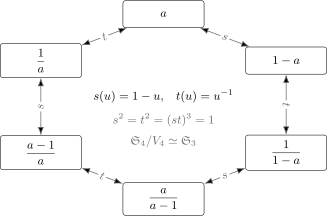
The generic cross-ratio orbit is the orbit generated by and . It collapses to three values on the harmonic orbit and to two values when .
The orbit of is only the geometric part. Exponent labels and must move with the punctures.
Moving the fourth point by a rescaling
Section titled “Moving the fourth point by a rescaling”Set
After multiplying the pulled-back equation by , one obtains
Therefore
while and are unchanged. The accessory transformation is forced by the numerator; it is not inferred from the cross-ratio.
Let denote the solution analytic at zero and normalized to one there. For the literal normalized germ identity below, assume . Resonant values require a separately declared limiting or logarithmic prescription. In a common neighborhood of zero,
The first Taylor coefficient checks the normalization. The target Heun series has coefficient
in its variable , hence coefficient in , exactly as on the left.
Moving infinity requires a prefactor
Section titled “Moving infinity requires a prefactor”Six of the 24 homographies keep infinity at infinity. The other 18 move it to a finite point, so one of the former infinity exponents must be removed by a gauge. A representative is
The transformed parameters are
The Fuchs relation gives . With the branch of equal to one at zero, the normalized local identity is
It holds first as an identity of normalized germs and then along continuation paths on which the coordinate and logarithm branches are transported consistently.
Index gauges exchange Frobenius exponents
Section titled “Index gauges exchange Frobenius exponents”At zero, try
The coefficient of the unwanted term in the transformed zeroth-order coefficient is
Thus leaves the chosen exponent unchanged, while exchanges the two exponent representatives. For the nontrivial choice,
with , , and unchanged. In the older Heun literature this is called an F-homotopic transformation. “Index gauge” makes its action more transparent.
The three finite points can be treated simultaneously. Set
where
and let
If , the transformed equation is again in general-Heun form with
The complete accessory map is
There is no term. One way to see the asymmetry is to recover from the residue at the distinguished point . Equivalently, compose the three elementary transformations in a fixed order, always using the already transformed parameters. The individual accessory shifts are
Choosing either exponent at each of three finite points gives index gauges, including the identity.
The shifted normal-form accessory coordinate from the standard-to-normal form map,
is invariant under all eight gauges:
At the same time, the selected exponent differences , , and change sign. Thus the eight standard-form representatives reduce to the same centered normal equation; the index gauges record which exponent representatives were used before centering.
These gauges are generally multivalued. On a fixed simply connected punctured domain they are invertible, but a positive loop around a selected point multiplies the gauge by . If is the corresponding monodromy matrix for the transformed equation, then
Projective monodromy is unchanged, while monodromy is twisted by a scalar character. Returning to an normalization requires a separate determinant-line retwist; it is not automatic. The branch factor is therefore harmless neither for linear monodromy nor for a normalized local function.
The discrete orbit has 192 automorphisms
Section titled “The discrete orbit has 192 automorphisms”The count is now immediate:
For generic parameters the group is
the Coxeter group of type . This is not the order-eight dihedral group that is sometimes denoted by the same symbol.
The order-24 stabilizer of one normalized local branch is abstractly isomorphic to , but it should not be identified naively with the literal that permutes the four punctures. The equation is also unchanged by . The conventional count fixes an ordering of the infinity labels and does not count this parameter relabeling as a new automorphism. Adjoining it can double a formal list, but it creates neither a new differential operator nor a new solution-space dimension.
A family automorphism need not fix one equation
Section titled “A family automorphism need not fix one equation”A generic element of the 192-element group changes the parameter tuple. It is an automorphism of the canonical family, not a symmetry of one fixed operator. Fixed-operator symmetry requires the transformed tuple to equal the original one.
For example, the rescaling fixes the tuple on the locus
There , and the equation is invariant under reflection. Whenever the analytic solution normalized by is unique, that germ is even. A harmonic or equianharmonic value of alone enlarges only the geometric stabilizer; exponent and accessory data must satisfy their own fixed-point conditions before the differential equation gains a symmetry.
A practical transformation algorithm is shorter and safer than a catalogue:
- choose the source point and one of its two exponents;
- choose a homography that carries it to the desired normalized point;
- add an index gauge if the selected target exponent is not zero;
- substitute into the differential equation and match all coefficients;
- enforce the Fuchs relation and compute explicitly;
- normalize the target germ and transport branches and paths;
- check a local coefficient and the Wronskian.
Normalized bases carry matrices
Section titled “Normalized bases carry matrices”The basis atlas on the preceding page fixed ordered local frames rather than unnamed solutions. A transformation must carry that additional data.
Let be the source frame at point , let be a target frame at the relabeled point, and write
The constant matrix restores the house normalization. It may contain leading-coefficient factors, a column permutation, branch phases, or—at resonance—a triangular Levelt renormalization.
Using the house connection convention
and the analogous target relation
one finds
This formula explains why a correct equation transformation can still give a wrong connection coefficient: the endpoint normalization matrices were dropped. At an irregular endpoint, is only part of the specification. The coordinate map also transports angular lifts, Stokes sectors, and lateral summation directions. Labels such as “ingoing”, “outgoing”, and “recessive” must be checked after the transformation.
Confluence is a singular limit, not another automorphism
Section titled “Confluence is a singular limit, not another automorphism”The confluence hierarchy page derived an exact general-to-confluent family. Fix confluent-Heun parameters with , set , and choose
As on a fixed outer -domain, the GHE tends to
The limit changes a regular singularity into rank-one irregular data at infinity, so it has no inverse within the Heun family.
An index gauge commutes with this limit
Section titled “An index gauge commutes with this limit”Let
and apply the zero-index gauge to every member of the general-Heun family. The exact transformed GHE parameters include
The transformed has precisely the scaling required by the Fuchs relation:
Consequently the lower horizontal transformation is the CHE index gauge
with
and , . For this generator, “transform then confluence” and “confluence then transform” commute exactly.
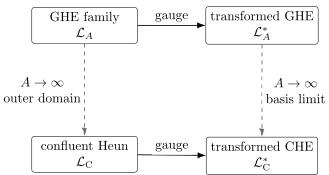
Horizontal arrows are invertible index gauges at fixed . Vertical arrows are singular limits on a declared outer domain; the right-hand limit also requires a controlled transformed basis normalization.
Not every general-Heun automorphism has such a limit. For example, the homography sends every fixed outer -domain toward as . It describes an inner scaling chart, not a nondegenerate outer CHE symmetry. A transformation survives confluence only when its coordinate, gauge, parameter map, domain, branches, and basis normalizers all have controlled limits.
The confluent equation has a different finite symmetry
Section titled “The confluent equation has a different finite symmetry”Part of the four-point symmetry disappears when one puncture becomes irregular, and part reappears as an exponential gauge. Besides the two finite-point index flips, useful CHE generators include
with
and
with
while and remain unchanged. Together with the two index flips, these generate the standard 16-element CHE transformation group. This is a new symmetry problem adapted to two regular points and one irregular point, not a literal copy of the 192-element general-Heun group.
Exceptional rational pullbacks
Section titled “Exceptional rational pullbacks”A Möbius map has degree one. A rational map of degree greater than one usually creates additional singular preimages and critical points, so it does not belong to the generic 192-element automorphism group. Exceptional nontrivial Heun-to-hypergeometric reductions by rational substitution require compatible cross-ratio, exponent, and accessory data. In Maier’s classification the admissible substitutions are polynomial. Harmonic and equianharmonic configurations give quadratic and cubic cases, but a symmetric value of alone does not guarantee a reduction.
This distinction matters computationally. A generic automorphism rewrites the same Heun-class problem. An exceptional pullback exists only on a lower-dimensional parameter locus and can genuinely reduce the equation to a simpler class.
A reusable transformation check
Section titled “A reusable transformation check”Before using a transformed formula, record:
- the source equation convention and ordered parameters;
- the coordinate , its inverse, and the working domain;
- the gauge and every logarithm or root branch;
- the full transformed coefficient functions;
- the image of each singular point and its ordered exponents;
- the transformed accessory parameter;
- the local or asymptotic basis normalization matrices;
- the continuation paths, angular lifts, and boundary labels;
- for confluence, the fixed variable, parameter ray, domain, and limiting basis renormalization.
A Taylor coefficient tests a normalized regular germ. Abel’s identity and the Wronskian rule test the gauge. Formal exponential parts and equal-magnitude rays test an irregular endpoint.
Common pitfalls
Section titled “Common pitfalls”Transforming only the cross-ratio. A Möbius map also permutes exponent labels and changes . Substitute into the differential equation; do not guess the accessory map from geometry.
Promoting an equation equivalence to a function identity. A map can send the source normalization point to a different singularity. A connection coefficient, branch phase, or leading factor is then required.
Reading 192 as a dimension. The number counts transformed representations. The solution space remains two-dimensional, with eight distinguished local branches in the generic four-point problem.
Ignoring multivalued gauges. Factors such as and carry scalar monodromy and branch-dependent constants. The equation may be correct while the claimed normalized solution is wrong.
Assuming every symmetry survives confluence. A finite- automorphism may collapse the outer domain or make transformed parameters diverge. Check the complete transformation specification before taking the limit.
Exercises
Section titled “Exercises”1. Derive the master substitution law
Section titled “1. Derive the master substitution law”Starting from and , derive the transformed equation and the Wronskian rule.
Solution
Let
The chain rule gives
and
Multiplication by gives
where
Now put . Since
division by yields
and
For two solutions,
On the other hand,
Equating these expressions gives
2. Move the fourth singularity
Section titled “2. Move the fourth singularity”Use to derive the map
and verify the normalized Heun identity through its linear Taylor term.
Solution
With ,
After multiplication by , the first-derivative coefficient is
The zeroth-order coefficient becomes
This proves the parameter map. A normalized Heun germ has
when . The transformed germ has coefficient
in . Substituting recovers in .
3. Exchange the exponents at zero
Section titled “3. Exchange the exponents at zero”Insert into the general Heun equation. Derive the admissible values of , the nontrivial parameter map, and the scalar monodromy twist.
Solution
Here
The coefficient of in is
Hence
For the second choice, matching residues and the behavior at infinity gives
with the remaining parameters unchanged. A positive loop around zero sends to , so
The two monodromies therefore have the same projective class but can differ as linear lifts.
4. Explain the number 192
Section titled “4. Explain the number 192”Count the homographic and index choices. Explain why the result does not give 192 linearly independent solutions, and determine the sizes of the cross-ratio orbits at harmonic and equianharmonic values.
Solution
There are
permutations of the four singular points and
choices of finite-point exponent index. Therefore
These transformations reorganize eight distinguished local branches, two at each singularity. Each branch has 24 equivalent representations, and all are solutions of second-order equations with two-dimensional solution spaces.
For , the six generic anharmonic expressions reduce to
so the harmonic orbit has size three. If , then and all six expressions reduce to the two conjugate roots. The equianharmonic orbit has size two.
5. Transport a connection matrix
Section titled “5. Transport a connection matrix”Suppose
at each endpoint. Derive the transformation law for in the house convention .
Solution
Substituting
gives
But
Therefore
If permutes columns, it changes the ordering of the basis. If it is triangular, as can occur in a resonant Levelt basis, the transformed connection matrix is not obtained by diagonal rescaling alone.
6. Commute an index gauge with confluence
Section titled “6. Commute an index gauge with confluence”Apply the zero-index gauge with to the exact GHE-to-CHE scaling. Show that the transformed family again has the required scaling form and recover the CHE parameter map.
Solution
The general-Heun zero-index map gives
For the accessory parameter,
Also . The transformed can be rewritten as
so the Fuchs relation and the exact confluence scaling are preserved. Taking yields
7. Diagnose a false local-function identity
Section titled “7. Diagnose a false local-function identity”The reflection gives the valid equation-level map
Why is the naive identity
generically false?
Solution
The symbol on the left denotes the solution normalized at . The target Heun function on the right is normalized at , which corresponds to the source point
Thus the right-hand side is a particular local branch based at the wrong source singularity. To express the zero-normalized source solution in that basis, one needs the connection coefficients between the bases at and , together with a continuation path and compatible branches. The equation parameter map is correct; the normalized-function identity is not.
References
Section titled “References”- NIST Digital Library of Mathematical Functions, §31.2(v) gives the three index transformations, the 24 homographies, and the 192 composite automorphisms; §31.3(iii), especially equations 31.3.12 and 31.3.13, gives normalized equivalent expressions and the eight sets of 24; and §31.12 states the confluent canonical equations and singularity patterns.
- R. S. Maier, “The 192 solutions of the Heun equation”, Mathematics of Computation 76 (2007), 811–843, especially Theorem 4.3, Corollary 4.6, Theorem 4.7, and §5, identifies the Coxeter groups and the eight-by-24 organization.
- A. Ronveaux (ed.), Heun’s Differential Equations, Oxford University Press, 1995, Part A, Chapter 2, pp. 14–29, develops homographic and F-homotopic transformations in the classical convention.
- L. Jaccoud El-Jaick and B. D. B. Figueiredo, “Transformations of Heun’s equation and its integral relations”, Journal of Physics A: Mathematical and Theoretical 44 (2011), 075204, records systematic general and confluent Heun transformation generators and emphasizes ordered parameter maps.
- R. S. Maier, “On reducing the Heun equation to the hypergeometric equation”, Journal of Differential Equations 213 (2005), 171–203, classifies exceptional Heun-to-hypergeometric reductions by polynomial substitutions, including the harmonic and equianharmonic cases.